
Acts of Claude: Building with Agents, a ‘Work in Progress’
by Paul Sawers
“Feeding the beast” isn’t a term you’ll find in any technical documentation or operational handbook, but it’s how Charlotte Roach describes the constant demand for project updates from those around her.
Charlotte is product director at UK online car marketplace Motorway, where she’s assembled a product team of 50. However, the majority of these team members are AI agents, each assigned a specific role and set of responsibilities, with access to their own tools and context – all in the name of getting work done more efficiently.
“Before I open my laptop, my ‘chief of staff agent’ sends me an update for the day,” explained Charlotte during a packed house at Index Ventures’ London HQ. Eleven builders had assembled for a show-and-tell of how they’re using Claude on projects internally.
At the centre of Charlotte's creation is Product OS, an AI-powered product management workspace built on Claude Code. It structures how work gets done across the product cycle – from discovery and experimentation through to delivery – using a set of persistent agents with access to shared context and memory.
Each agent is defined as a text file with a role, a set of responsibilities, and access to specific tools and context. There’s a “chief of staff” agent coordinating priorities and follow-ups, a product manager agent running experiments, and specialist agents – think “analyst” and “UXR” –– pulling signals from a large body of customer data.
Together, they form a system that can investigate, draft, prioritise, and report, without needing constant direction. And perhaps most importantly, this helps keep the proverbial beast well nourished.
“It’s not even nine o’clock, and I’ve investigated an experiment, drafted a Notion doc, scheduled some meetings, followed up with my team members, and ‘fed the beast’,” Charlotte said – shorthand for keeping the constant flow of updates moving.
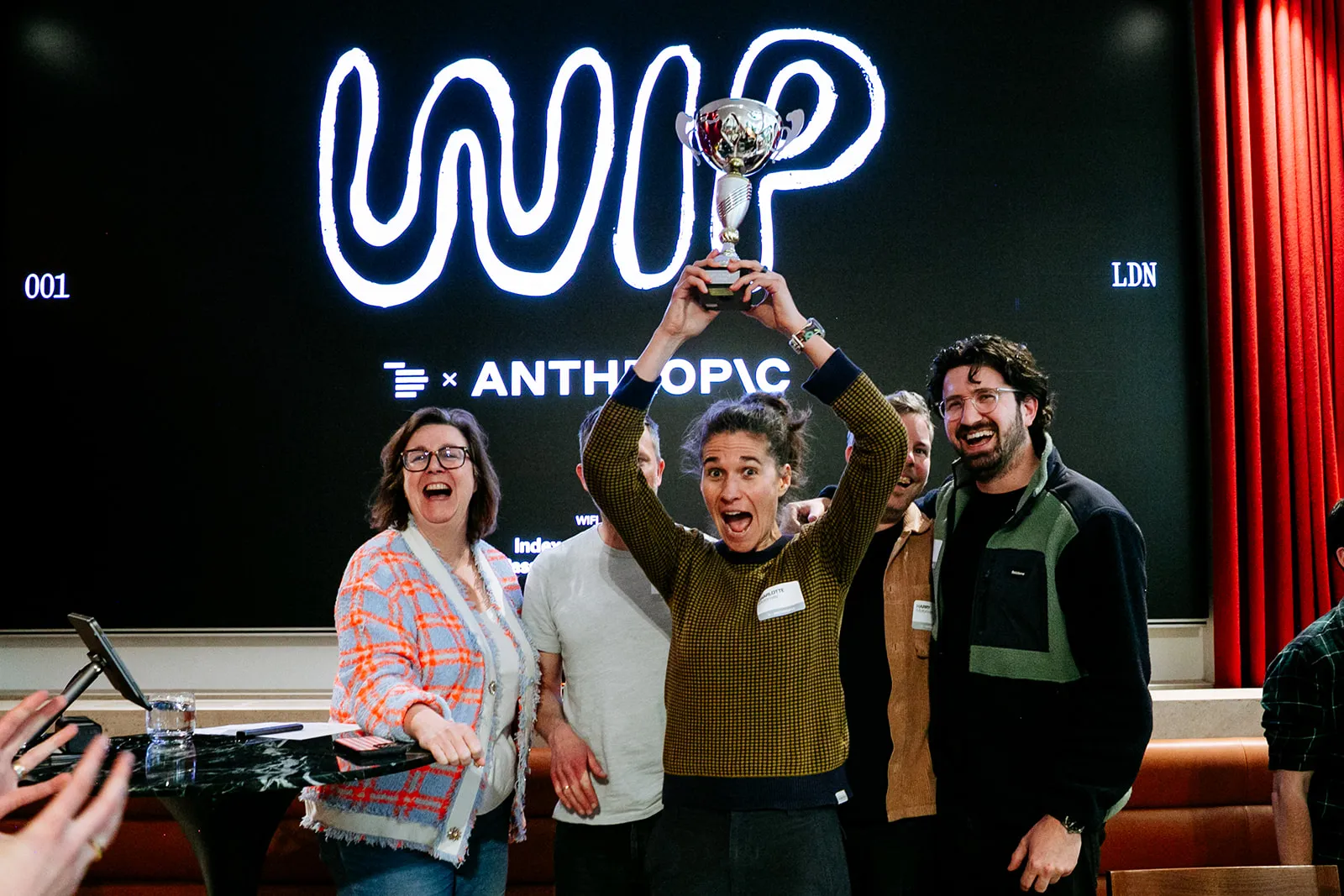
Charlotte, as it happens, won the crowd’s vote for best demonstration of Claude Code at work. But across the room, individuals from a range of companies stepped up to show what they’ve been building with Claude Code internally.


Inside WIP: Index x Anthropic
Vibe decoding: Learning in real life
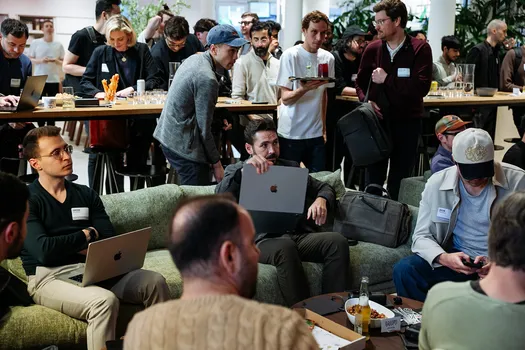
Reading the vibe in the room, the afternoon was perhaps less about showing shiny products than about sharing ideas.
Revolut’s Nikita demonstrated his “second brain” to turn fragmented projects, notes, and data into something structured and searchable, while Wiz’s Vlad walked through a code generation system that produces the code needed to integrate new SaaS platforms for a security scanning product.
“I think there's so much about how AI changes how you're going to work – whether you're building a product with it, or if you're putting AI in your product — and those two things are very complementary to one another."
—Lawrence Jones, Incident.io
Elsewhere, ElevenLabs’ Lauren showed how her team is configuring agents in bulk for demos and growth workflows; Nexos’ Mario presented a proactive agent system built to operate with deep, persistent context; Saily’s Vykintas demonstrated Figma prototyping tool that’s reached company-wide adoption ; and Ankar’s Charlie showcased a custom tool for managing customer feedback, product priorities, and feature announcements.
Different problems, different implementations – but an eagerness to show how things are actually being built.
For Charlotte, the value of the event lay in seeing how others were approaching similar problems to her – particularly around managing context and deciding what information actually matters, offering ideas she could take back into her own system.
And that sense of cross-pollination came up in conversations elsewhere. Lawrence Jones, a founding engineer at Incident.io, presented an internal system that investigates and diagnoses incidents automatically. But for him, the benefit of being in the room was just as much about seeing how others are working.
“I think there's so much about how AI changes how you're going to work – whether you're building a product with it, or if you're putting AI in your product — and those two things are very complementary to one another,” he said.
“By the time you come to an event like this and you see how people are doing things, it tells you a lot about different techniques that people use.”

Magnum opus (4.5): Harnessing AI’s potential
Across the demos, one thing stood out: most of what was on display was brand new. Charlotte, for example, said that Motorway’s Product OS was only initiated in January this year, a fledgling effort in the grand scheme of things.
So why now?
For Volodymyr Giginiak, chief technology officer at AI-powered legal tech company Wordsmith, the answer is simple.
“Opus 4.5 – it’s absolutely that,” he said.
Each new model release, of course, brings gains — handling longer, more complex tasks, better reasoning, and requiring less supervision. But the arrival of Opus 4.5 back in November was a watershed moment for agentic development, making a certain class of product viable in ways they weren’t before.
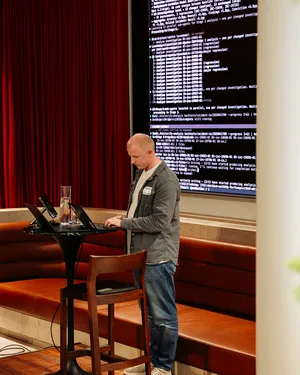
At Wordsmith, Volodymyr is building an internal development platform that runs through Slack, allowing anyone in the company to spin up a virtual machine, make changes to the codebase, and generate a pull request – complete with screenshots, videos, and logs. Feedback is funneled back into the same environment, allowing the system to iterate until the work is ready, with everyone working from the same interface.
“Basically, what it achieves is that it gives non-engineers a way to almost do an engineering job,” Volodymyr said. “They can make a change, or they can get some analytics out of it, without actually running the environment themselves. Because using Claude Code is pretty easy for non-engineers as well.”
That kind of setup, he suggested, only became viable once the models crossed a certain threshold.
"It's probably not something that I would build at all, to be honest," Volodymyr conceded. "It would require a lot of resources, and I just wouldn't feel like it's something that I could afford to do."
That view was echoed elsewhere in the room. As Margot van Laar, applied AI engineer at Anthropic, put it, the limiting factor is no longer the model itself, but the systems around it – how it’s guided, what it can access, and how far it’s allowed to run.
“Model intelligence is no longer the bottleneck of long-running AI systems,” van Laar said. “It’s the harness and the ability to build trust into these systems to allow them to run for a long time.”
Anthropic is already moving in this direction, recently launching a managed service that runs agents on its own infrastructure, with built-in memory, tooling, and guardrails. In other words, the value is moving to the harness around the model—how it’s controlled, what it can access, and how it’s run.
This isn’t limited to Anthropic, either. Across the industry, companies are starting to package this control layer as a product in its own right, running agents in managed environments rather than leaving teams to assemble the pieces themselves.
For the startups in the room, that means a different set of problems to solve. Less time spent wiring up the basics, more time deciding what these systems should actually do, and where they should be allowed to operate.
Opus 4.5 may have opened the door, but what comes next is about building the trust and the tooling around it, and figuring out how far these systems can be pushed under real conditions.
What's going on with AI is much more akin to the Industrial Revolution. Creating companies, and being entrepreneurs, has never been more important.Danny Rimer,
Partner at Index Ventures
‘A work in progress’: Industrial revolution 4.0
This sense of uncertainty ran through much of the day, a theme that was baked into the heart of the event itself. “Work in Progress,” as Index Ventures partner Danny Rimer explained, is an acknowledgement that we’re still figuring this out as we go.
“‘Work in Progress’ really represents what our whole journey has been at Index,” Danny said. “That [...]we're always trying to reinvent ourselves.”
We have been here before, of course. The past 35 years have seen successive waves of change, from the early web to mobile and the rise of cloud computing.
For Danny, however, this moment stands apart.
“I do feel like this moment makes the internet seem like a blip,” Danny said. “What's going on with AI is much more akin to the Industrial Revolution. Creating companies, and being entrepreneurs, has never been more important.”
Published — May 6, 2026
-
 This link opens the post, "Ando: Building the Interface Layer for Human and Agent Teams"
Ando: Building the Interface Layer for Human and Agent Teams
This link opens the post, "Ando: Building the Interface Layer for Human and Agent Teams"
Ando: Building the Interface Layer for Human and Agent Teams
-
 This link opens the post, "Building A New Energy Model For Europe: Our Investment In Nomos"
Building A New Energy Model For Europe: Our Investment In Nomos
This link opens the post, "Building A New Energy Model For Europe: Our Investment In Nomos"
Building A New Energy Model For Europe: Our Investment In Nomos