Making Quantum Computing Real: Our Investment in Oratomic
In 1994, Peter Shor showed that a quantum computer could factor large numbers exponentially faster than any known classical method. It was exciting, a bit terrifying (most of the world’s encryption relies on factoring being hard), and the first sign that such a machine could do something useful. Yet many physicists dismissed it. A quantum computer, they argued, was just a kind of analog computer, and analog computers don’t work. They run on continuous numbers, so every small imperfection compounds until the calculation goes off track.
A year later, Shor and others found the answer: quantum error correction. It showed that a computation could be analog in nature but corrected digitally. Without it, a quantum computer is no more powerful than an ordinary one. Error correction is the reason the field exists.
The catch was scale. Error correction was expected to take millions of qubits, and the best labs had a tiny fraction of that. Meanwhile, an entire industry took shape around machines without it, touting qubit counts, gate speeds, and benchmarks — effectively fairy dust. The machines never delivered commercial value, the field stayed perennially 10 years away, and a lot of smart people learned to roll their eyes at the word “quantum.”
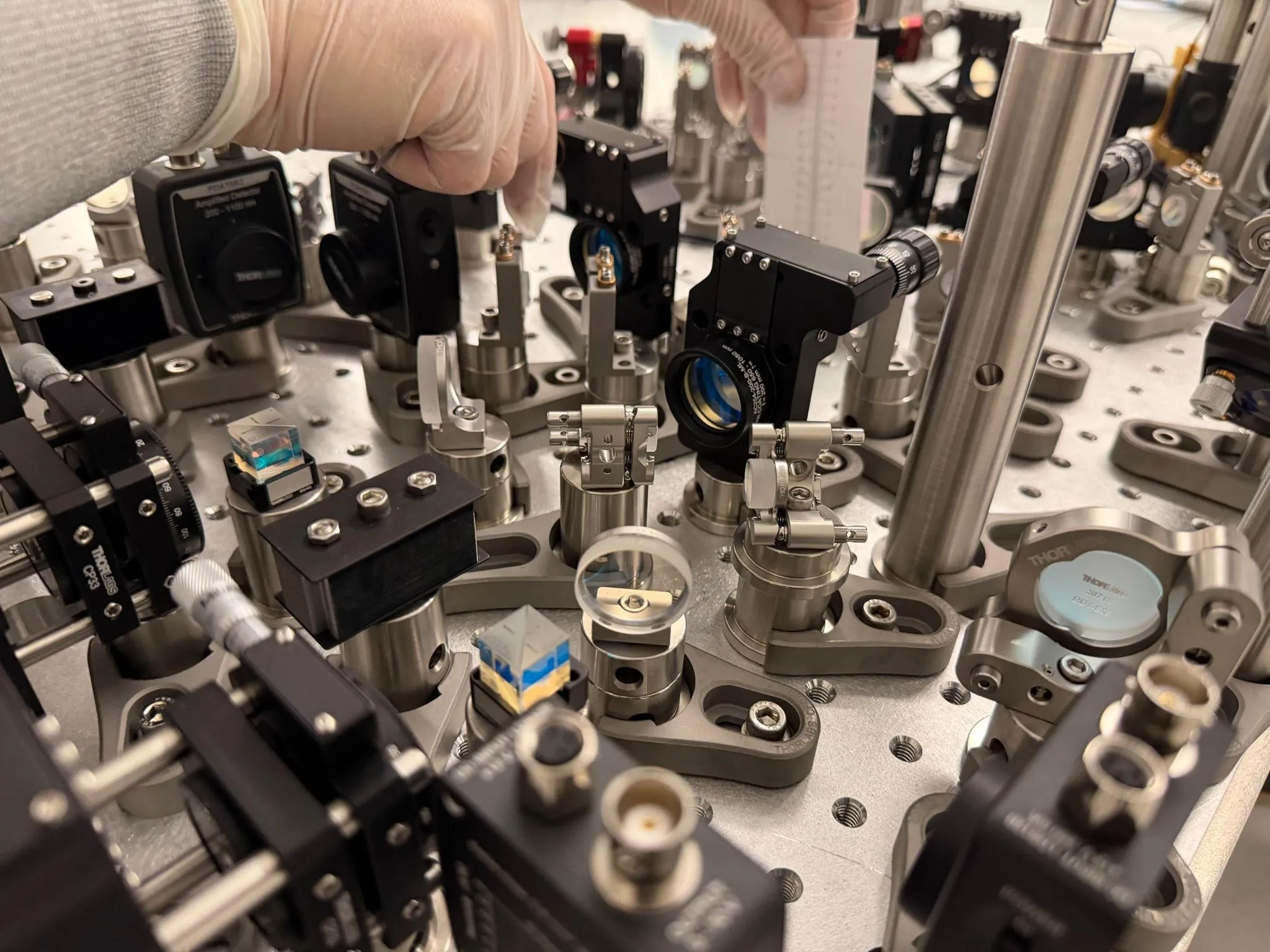
Nearly three decades after Shor’s breakthrough, a handful of Harvard PhD students led by Dolev Bluvstein did something the world’s top quantum labs had been chasing ever since: they ran a quantum algorithm that could correct its own errors, using a new kind of machine built from neutral atoms reconfigured dynamically by tightly focused lasers. Physics World named it the 2024 Breakthrough of the Year.
The result showed a path toward fault-tolerant quantum computing, but also how far there was to go. A few hundred qubits was still a long way from the millions a useful machine was expected to need, and getting there would take advances across atomic physics, error correction, optics, control systems, and large-scale engineering.
The foundation had been taking shape for years. In 2016, Manuel Endres pioneered a way to hold individual atoms in optical tweezers and assemble them, atom by atom, into large, defect-free arrays. At Caltech, where he built one of the field’s leading labs, he kept pushing the technology further, and in 2025 his team trapped 6,100 atoms in a single array, the largest ever built. Dolev, meanwhile, had shown how to use those reconfigurable arrays for error correction. When Manuel recruited him to Caltech as a professor, the two shared an ambition to push these ideas toward machines with millions of qubits, ones that would be capable of useful computation.
Caltech offered an unusual model for thinking at that scale. Its scientists and engineers had built some of the world’s largest optical telescopes, the LIGO detectors that first heard gravitational waves, and spacecraft at JPL. A quantum computer could be approached in much the same way, as one large scientific and engineering project built around a single goal.
Others brought their own critical pieces of the puzzle. John Preskill, Caltech’s Feynman Professor of Theoretical Physics, had spent three decades laying the groundwork, writing some of the seminal papers on fault-tolerant quantum computing and building up the university’s quantum community. Robert Huang, a theorist and former Google researcher, had developed new tools for understanding what large quantum computers can do, including the first rigorous proof that they can process classical data with exponentially fewer resources. Madelyn Cain had worked across experiment and theory to make error correction practical on neutral-atom machines. And Qian Xu had developed methods for computing efficiently with high-rate quantum error-correcting codes.
Together with Dolev and Manuel, they set out to find quantum’s version of “Attention Is All You Need”, the paper that took AI from decades of skepticism to something that suddenly felt inevitable. Within months, they had written it. The group showed that because neutral atoms can physically move around during a computation, any qubit can talk to any other, and with the high-rate codes, error correction becomes dramatically cheaper. A useful machine, it turned out, needs only around 10,000 qubits, a scale they were already close to in the lab. It also meant they were within reach of a design that could break the world’s encryption, which is not something you build in the open. So in March 2026, they founded Oratomic.
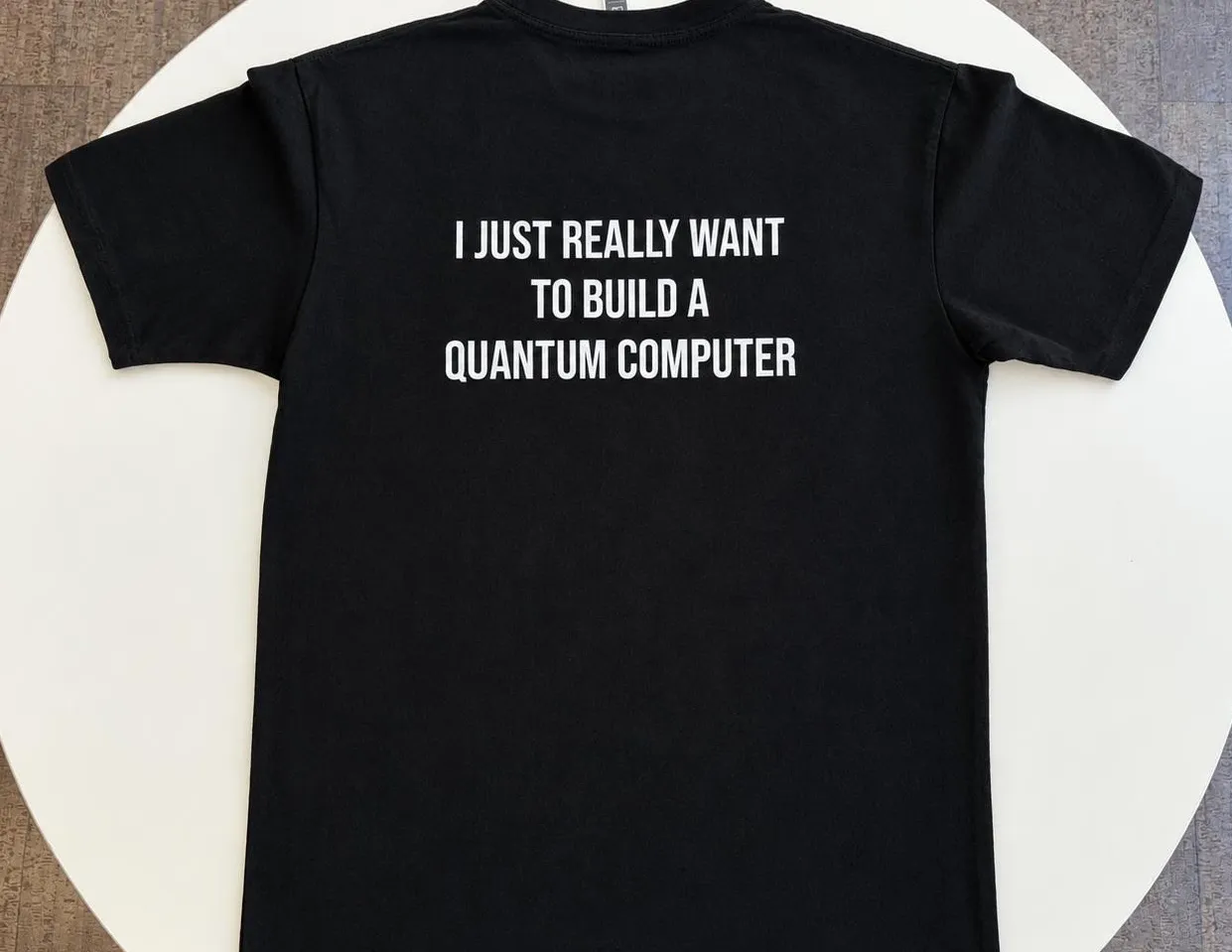
We’re not quantum experts, but we are entrepreneur experts, and in this team we see the traits that define the very best founders: the intensity, the conviction, the obsession, the drive. Multiple people have described them to us as the “Avengers of quantum.” When you talk to Dolev, their CEO, it’s immediately clear he cares about one thing only: building a fault-tolerant quantum computer. (His team had a shirt made for him that reads “I just really want to build a quantum computer.”)
The whole team speaks with a kind of infectious certainty, like they’re about to crack something enormous and can’t wait to see what happens next. When we visited them in Pasadena, John, who has watched the field grow up from the beginning, called Oratomic “the most exciting thing that’s happened in my lifetime.” Already one of the most brilliant groups we’ve been around, they’re quickly adding the optical, mechanical, and software engineers they’ll need to build the first useful quantum computer. The chemistry is palpable: everyone is bought into the mission and talks about the computer as a matter of when, not if.
If they succeed, it will fundamentally change what computers can do. Modern computing as we know it, from the PC to the internet, was built on classical bits. A fault-tolerant quantum computer is a new type of machine, the first that can reliably work with information the way nature stores it. It could let us understand and design molecules that classical computers can’t touch, opening new paths in chemistry, materials, medicine, and basic science. The most important uses are probably the ones nobody has thought of yet, just as the early builders of classical computers couldn’t have pictured the smartphone or generative AI.
We believe Oratomic has all the makings of one of the most consequential companies of its generation. We’re thrilled to partner with Dolev, Manuel, Robert, John, Madelyn, Qian, and the whole “Avengers” team, and to support them as they build the world’s first fault-tolerant quantum computer.
Published — Oct. 8, 2026