Journeys by Archetype
The impact of US expansion on organization design varies widely depending on your archetype, with the exception of engineering. A summary of each potential journey is presented below.
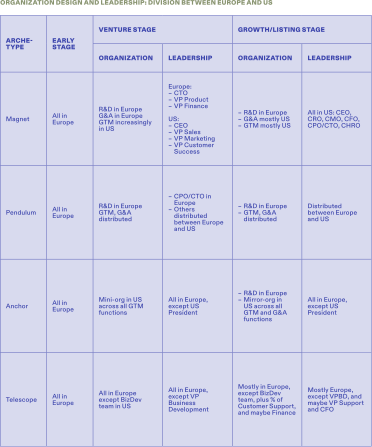
Scaling Magnets
Magnets are characterized by a pivot of the whole organization to address the US market. If the founder has moved and US commercial traction is established, this has a ripple-effect on all other functional teams and on the leadership. At the point of IPO or listing, the entire leadership team will be in the US, along with about 50 percent of the overall team.
Product
In the early stages, your product team needs to be close to engineering to allow for close collaboration. However, following a transatlantic build-out, the requirements of US customers will drive your product roadmap. It’s essential that your product team is sensitive to the needs of the US customers, hearing from them firsthand, or directly from US-based sales and customer success teams.
This can be achieved while keeping your product team co-located with engineering, but you need to put in place rigorous processes to foster communication and collaboration with the US GTM teams.
High-quality engineering talent and strong product experience means that maintaining Israel as the center of gravity for R&D makes sense for most Israeli companies. But this can’t be done successfully without heavy ongoing investment in a culture of cross-border collaboration.
Gil Dibner, Founder and General Partner, Angular Ventures
However, what we usually find is the creation of a dual product team. The majority (maybe 70 percent) of product managers with a technical orientation will remain in Europe alongside the engineering team. A smaller team of (usually more experienced) product managers with an explicit customer-orientation will be hired in the US.
At later stages when the product organization grows in complexity, there’s increased pressure to hire an experienced leader––someone with the authority to counterbalance demands from the sales team with product integrity and the ability to maintain a consistent and integrated product roadmap. The talent pool of proven Chief Product Officers is very heavily weighted to the US, which results in a further push towards the continent. This individual will often oversee engineering through a direct report from Europe-based VP of Engineering.
GTM
Sales and marketing organization and leadership will rapidly pivot to the US, reflecting the growth opportunity, growth focus, and the availability of talent. This naturally creates tensions during the transition, particularly if early GTM leadership is already in place in Europe.
It was tough matrix-managing a lot of people with hard dotted lines to our Lausanne functional leaders. It’s the biggest challenge.
Mary Beth Vassallo, former VP and GM North America, Nexthink
Over time, you will probably appoint a VP of Sales in Europe, responsible for sales activity across the whole region, who reports into a US-based CRO. If European R&D is in a secondary hub, the European GTM hub may well be in a different location, London or Amsterdam being the most likely.
G&A
As the commercial focus shifts to the US, functions such as finance and legal will tend to follow, albeit at a slower pace. The “2.0” G&A leadership hires are likely to include a US-based CFO, General Counsel, and Chief People Officer.
CASE STUDY


-
Transforming the norms of enterprise software from Romania.
-
About
UiPath is an agentic automation platform enabling agents, robots, people and models to work together.
-
Founding
2005 in Romania as DeskOver, pivoted and rebranded to UiPath in 2015.
-
Founder(s)
Daniel Dines, Co-founder and CEO;
Marius Turca, Co-founder and former CTO -
Founder location
New York
-
Listing
2021 in New York Stock Exchange (NYSE)
-
Fundraising up to listing
$2 billion, series F
-
GTM
Field sales and channel sales
-
Headcount
4,000+ employees globally
-
Leadership
Primarily in New York
-
Engineering
Main hubs in Bucharest, Bangalore, and Seattle
History
Daniel Dines and Marius Turca founded DeskOver in Romania in 2005. It was a lifestyle business, making $300,000 a year providing automation libraries and a Software Development Kit (SDK). Developers discovered the software through SEO and Adwords, and their users included teams at IBM and Microsoft.
In the beginning, my motivation was to achieve the minimum wealth I needed to have a decent life. But to be an entrepreneur you need the hunger to achieve something from deep within.
Daniel Dines, Co-founder and CEO, UiPath [DD]
Daniel’s eyes were opened to the Robotic Process Automation (RPA) opportunity when a customer told him that they were using DeskOver for task automation.
We were building an engine, and selling that engine to other garages … we didn’t yet know what we could do with it. Until somebody told us ‘you can use it to build an airplane.
Adrian Dorache, early developer, UiPath [AD]
The shift to RPA
In 2012, with a team of 10, they built a basic RPA product aimed at SMBs. At the time, they were bootstrapping the company through consulting revenues, which was a distraction.
You’re much better off raising money through an accelerator program. But in our time that just didn’t seem possible from Romania.
DD
With hindsight, the team felt that they went in the wrong direction for a few years.
We launched our product too slowly. We polished it too much, and we killed it too late.
DD
The turning point came in 2014 when they were contacted by a major Indian Business Process Outsourcing (BPO) who was pioneering RPA, and who wanted to work with DeskOver. Daniel sent a team of three to India for three months, to get immersed in the problem and implementation.
This was an astral moment, and I felt it could be our break. We didn’t think in terms of PMF back then, but looking back, this was what got us there.
DD
From DeskOver to UiPath
Between 2014 and 2015 the team grew from 10 to 100. They grew their enterprise customers from 100 to 700, and in 2015 changed their name to UiPath.
Customer leads were still almost all inbound, through a free-trial offer. But deepening relationships with systems integrators (Cap Gemini, Cognizant, and others) created a strong channel to enterprises. EY Romania was a key strategic partner, and they got UiPath in front of global corporations.
In 2015, UiPath raised a $1.6 million seed round, and flipped to a US TopCo.
The path to scale
In 2016, they reached $5 million ARR through an inside sales team in Romania, who sold remotely into the US.
You can build good relationships remotely nowadays. We were introduced to GE via a partner, and our Romanian inside sales team closed it at $300k.
DD
Enterprise products were rolled out, and offices opened in London and Bangalore.
Web traffic grew from 10,000 per month in 2014, to 1.5 million in 2016. This indicated a much broader base of interest beyond individual developers.
DD
Shift to the US
2017 proved to be a huge year for UiPath on multiple fronts. In January, they hired a US Sales leader following a search process. He was solid, experienced, and ran the US until recently, building inside and field sales teams. A top Romanian sales rep moved over to support him. Pre-sales was covered through a lot of travel by the Romanian team.
Daniel started spending four or five months per year in New York, often with his wife and baby.
My being in New York wasn’t significant for closing US sales. But it helped for hiring US execs.
DD
In February, Forrester ranked UiPath as a leader in RPA, which made a material difference.
The ranking counted a lot. It matters what analysts say. Besides just making sales, your product needs to be very good, and by the time this report came out, we were a company that delivered. This is important, because big companies want to deal with big companies.
AD
In April, a large series A provided fuel for expansion. By this point they were servicing 200 enterprises (40 percent Europe, 30 percent US, 30 percent Asia).
By the end of 2017, they had also built a field sales team of 40 across Europe, the US, and Japan. They achieved $45 million in ARR, and doubled their direct sales contribution. Overall, headcount grew from 250 to 500, across 10 offices.
Over the next two years, hypergrowth continued, to $150 million ARR in 2018, and $300 million in 2019. In parallel, Daniel raised three huge rounds, taking the company to a latest series E valuation of $10.2 billion.
Our culture is built on humbleness. What can make us successful is really the desire to do something better, to become better. Only people who think from a position of humbleness can improve.
DD
Engineering and product
Securing engineering talent in Romania was initially tough, because employees were not willing to take the risk of joining an unproven startup. But there was some success, including a 2016 developer hire who now runs the Romanian engineering team.
Romania was not a good place to build a business. Although there is good engineering talent they are scared of startups. Our success should change the ecosystem. It shows that we’re now in a global era, when it doesn’t matter where you start, if you have ambition and a good product.
DD
We had product owners in Romania, but really they were technical program managers. Effectively, I was running product for a long time.
DD
In 2018, UiPath opened an additional engineering center in Bangalore. They saw AI/ML integration as key to product innovation, so they hired a CPO in Seattle from Microsoft. This led to building a 100-strong engineering and product team there, focused on innovation. However, the core engineering is still mostly carried out in Bucharest.
Scaling Anchors
In the Anchor archetype, building out a transatlantic organization involves the creation of a condensed mirror-organization across GTM and General and Administrative (G&A) functions in the US, and hiring a US President. Expansion tends to happen later in the journey, by which point “2.0” European functional leaders are likely to be in place. The US is not expected to become the dominant market in terms of revenue share, although it may become the highest-revenue single country (20–30 percent of total). At the point of IPO or listing, the leadership team will remain entirely or mostly in Europe, along with over 70 percent of the overall team.
Matrix management in the Anchor model can be tricky. With most functional leadership sitting in Europe, it’s usually best to give significant autonomy to the US, so that they can optimize for US market needs. In practice, this means dual-reporting lines for US functional heads, but with the stronger line into the US President for sales, marketing, and customer success functions. Ideally, the US President will be responsible for the full US P&L, although this depends upon your business model.
Unlike in the case of a Magnet, the product function usually stays in Europe alongside engineering, although you may scale to having one or two US-based product managers focused on ongoing localization.
For our product teams, being close to customers is important, but being far from engineering is a risk.
Ingo Uytdehaage, Co-CEO, Adyen
CASE STUDY


-
Relentless experimentation and execution.
-
About
Revolut is a digital banking platform providing financial services including multi-currency accounts, payments, and trading.
-
Founding
London, 2015.
-
Founder(s)
Nik Storonsky, Co-founder and CEO;
Vlad Yatsenko, Co-founder and CTO -
Founder location
UK
-
Fundraising up to listing
$1.7 billion, series E
-
GTM
Direct-to-consumer, digital-first approach through mobile and website, largely driven by referral programs
-
Headcount
11,000 employees globally (60% Europe, 10% US, 30% RoW)
-
Leadership
Primarily in London, apart from a few regional executives
-
Engineering
Europe
Our approach has been to go and to see what sticks. You can’t analyze your way to the US.
James Gibson, GM, Revolut Business, and Partner, Revolut [JG]
Building a global super-app from day one
Revolut was founded in London 2015 by Nikolay Storonsky and Vlad Yatsenko with the mission of making everything to do with money simpler, faster, cheaper, and more transparent. Storonsky, who had previously worked as a trader at Credit Suisse and Lehman Brothers, knew how frustrating it was for consumers to endure fees and bad exchange rates while traveling. He partnered with Yatsenko, who brought deep technical expertise from his background as a software developer at Deutsche Bank and Credit Suisse.
The founders’ combined depth of knowledge about finance and engineering proved crucial in building what would become a global financial super-app. Starting with a prepaid debit card and app focused on currency exchange, they rapidly expanded to include multiple financial products and services. By focusing on cross-border foreign exchange (FX) and payments at the outset, the more fragmented landscape of Europe was a better starting point for Revolut than the US, which is a single currency. The company developed its own core banking platform to service all jurisdictions and products—a technical achievement that had previously eluded both traditional banks and startup banks. They maintained a single app that recognized users’ locations and personalized their experience accordingly, allowing for efficient scaling across markets.
Using European success to build a global foundation
By 2018, Revolut had become a licensed bank in Lithuania, allowing it to offer deposit and lending services across the European Union. This regulatory foundation, combined with their technical infrastructure, positioned them for global expansion. The company now has 40 million users globally, operates in over 35 countries, and allows fee-free spending in more than 140 currencies. Yet its ambition is even bigger. Speaking to Index Partner, Martin Mignot at Slush, founder Nik said:
We want Revolut to be the No. 1 global bank in 100 countries, with 100 million daily active customers and $100 billion in revenues a year. It’s doable because the market is so huge and banks are fragmented and not competing globally.
Nikolay Storonsky, Co-founder and CEO, Revolut [NS]
Early US strategy: taking a patient approach
Revolut launched its business product in the UK in 2017, and began preparing for US expansion the following year. It launched its retail product in the US in 2020 with a US-based team. James Gibson, who leads Revolut Business, moved to the US in 2021 to drive product growth and build out the local team.
In 2022, Revolut appointed Sid Jadoja as US CEO, based in San Francisco. Jadoja had joined as Chief Banking Officer in 2021, bringing valuable local market expertise. Revolut has country leaders reporting directly to Nik, the founder.
It’s important for the CEO of a new territory to report directly to the founder. The learning cycles are much faster that way.
NS
Experimenting with products: let performance guide decision making
At Revolut, it is much more about execution than strategy. We go all in with all our products and we see how they do. We analyze the results rather than guessing at what will work.
JG
Revolut took an execution-focused approach to the US market, letting product performance guide their strategy.
This iterative approach helped reveal clear market differences. In the US, they found particular traction with international payments and FX services, while seeing less demand for spend management features due to strong local competition. They also spotted a big opening in remittances.
My biggest advice to European companies entering the US is to see what works and be ready to adapt. Get local feedback and make sure you are tracking product metrics.
JG
Team structure and culture: balancing global ambitions with local execution
Revolut maintains a highly distributed team structure in the US, with personnel across operations, risk, compliance, finance, and product. Rather than concentrating entire functions in specific locations, teams are decentralized.
However, Revolut is also very intentional about maintaining its culture by moving people around where necessary. The company often sends European team members to work from the US office, because they carry the company’s culture with them. Gibson doesn’t advise being remote or distributed at the start.
I would advise European founders to get an office and have an in-person office culture from day one. When you’re a small team trying to grow in a new market, trying to do that in a distributed way is very hard.
JG
When it comes to scaling engineering teams, Revolut has tried to balance investing in the core product versus market-specific customization. While it’s tempting to create separate engineering teams for each market, this often leads to fragmentation.
If you have all these teams just hacking at the same thing, you’re gonna end up with a big mess quickly. You have to balance the trade-off between investing in the core product, which helps in all markets, or investing in your market.
JG
Revolut’s top tips for winning in the US
- Build culture through people: Rather than trying to transplant culture through policies or documents, move actual people. Gibson’s rule of thumb is that, where possible, over 30 percent of new office staff should come from existing locations.
- Experiment fast, scale slowly: Launch products quickly, but scale investment only when you see traction. Don’t overinvest before finding PMF, but be ready to double-down when you see success.
- Maintain technical unity: Resist the temptation to create separate engineering teams for each market. Focus on building a strong core product that is configurable across markets, rather than creating a completely separate product per market that can lead to fragmentation and create a lot of technical debt.
- Treat it like a startup: Approach US expansion as if you’re building a new company, not just extending an existing one. Be prepared to adapt your product and approach based on local market feedback while maintaining alignment with global operations.
Scaling Pendulums
The Pendulum archetype poses the toughest leadership and management challenges in a transatlantic organization. Distributed leadership works best when functional teams are built on a distributed basis from early on. In fully remote teams, this approach is part of the DNA of the company. But if your initial engineering team is centralized, a deliberate “remote-first” decision needs to be taken when hiring later for functions such as marketing and finance.
My advice is that if you truly believe your company is going to be big, don’t accrue organizational debt; adapt to distributed leadership early—definitely once you’re post-series B. Especially today, with remote working being more viable and desirable.
Daniel Ek, Founder and CEO, Spotify
Having a distributed leadership team works fine for an early-stage startup where everyone is used to the rough and tumble, and are just working to get things done. Collaboration is harder on the individual- contributor level, but at leadership level, people make it work.
David Helgason, Founder and former CEO, Unity Technologies
Sometimes there is no ideal org structure. A good strategy is to change the design every couple of years, like multinational corporations tend to do, keeping ideas and relationships fluid.
Dom Vidal, Index Ventures
CASE STUDY


-
A blueprint for leadership excellence.
-
About
Miro is the AI-powered innovation workspace that helps teams move fast from idea to outcome.
-
Founding
2011
-
Founder(s)
Andrey Khusid, Founder and CEO
-
Founder location
Amsterdam
-
Fundraising to date
$477 million, series C
-
GTM
Product-led growth to drive bottom-up adoption paired with enterprise land-and-expand model
-
Headcount
1,600 employees globally (60% Europe, 35% the US, 5% RoW)
-
Leadership
Primarily split between the Netherlands and the US
-
Engineering
Europe (larger hubs in Amsterdam, Berlin, and Yerevan, smaller hubs in London and Copenhagen)
-
US % of TAM
50%
-
US % of Revenue
40%
Early days: PLG across the world
In the early days, Miro was driving organic growth across all markets. They found the product was most relevant in developed markets that were well versed in design thinking and visual collaboration. The team optimized search for these markets and achieved $600,000—$700,000 ARR with product-led growth (PLG) and organic marketing channels.
US testing to a repeatable playbook
By analyzing their subscriptions data, Andrey and his team saw that there were a number of users from big companies in the US. This spurred them to go to the US and try to take these initial few user subscriptions and start upselling to corporates. Andrey spent some time in the US in 2015, hiring a part-time leader and few junior sales folks in the Bay Area.
At the time, Miro was growing slowly and profitably and didn’t have huge amounts of money to spend on doubling down on the US. They chose to hire a Head of Sales who worked part-time, for a few hours a day. Miro discovered that, typically, the larger US companies had experimental budgets of up to $20,000 to test new software tools. The team priced their product and licenses at $15,000 for 50 users and by 2017 had grown to $1 million in enterprise sales and a few million in self-serve.
I don’t know if I would recommend this approach today, with a much more competitive market, but at the time, this is what worked for us.
Andrey Khusid, Founder and CEO, Miro [AK]
Building US network: seeking excellence
Andrey spent a lot of time in the US, meeting SaaS leaders, to calibrate what top talent looks like.
I wanted to educate myself on different profiles and different mindsets to understand what awesome looks like.
AK
He looked for candidates on AngelList, thinking that this would be a hub for entrepreneurially minded people. By filtering for people with experience in other startups with a PLG approach, he reached out to lots of people and had positive conversations, which ultimately led to his first Head of Sales and Head of Marketing hires.
He also used LinkedIn, asking his network for introductions and then asking new people he met for further introductions. Attending conferences in the US also proved a good way to meet people. Hearing from leaders on stage, he was able to identify who resonated with him, spending time with them after their talks and emailing them with follow-ups. This allowed him to meet Elena Verna, who advised the team on growth and ultimately became Interim Head of Marketing.
I’ve been hiring in the US for 10 years now and I can tell you it is challenging even with a broad experienced talent pool in B2B SaaS that has the most concentration in the US! Spending time on meeting lots of people and calibrating your personal bar is crucial—even then you won’t get it right 100 percent of the time.
AK
Ready to scale: investment in the US
In 2018, Miro raised a $26 million series A from Accel and was ready to scale faster. From 2018 to 2019, Andrey spent significant time in the US hiring the team and figuring out a scalable GTM motion.
As a European startup, you begin in a non-competitive position for top US talent. They have so many opportunities with proven local founders. How do you attract top talent to your company?
AK
Andrey worked his way up to recruiting more and more experienced talent, believing that the leadership team is crucial in building out the company. He found that it is very challenging to make decisions based on interviews alone, as there were many candidates that both he and his leadership team were impressed by. It was through detailed referencing that they filtered out the candidates who would not be a fit.
I learned to spend time on references and back-channeling to get a full 360° picture of a candidate.
AK
Andrey hired Miro’s first CRO, Zhenya Loginov, who was previously at Segment and Dropbox, when the company hit $12 million in ARR (30 percent coming from enterprise).
Org design with most tech in Europe
The US team is mainly GTM hires in the Bay Area and Austin. Europe had both GTM hires and tech hires with the main tech hubs in Amsterdam, Berlin, and Yerevan. Over time, via acquisitions, Miro has acquired tech talent in the US.
I find having US tech talent is helpful in the company. In general they have a higher sense of urgency that can then be transmitted across the broader company.
AK
Up until 2022, Andrey was intentional about optimizing for hubs when hiring executives. Nowadays, he is more focused on hiring the best leadership talent globally. They now have their Chief People Officer and CRO in Amsterdam, their Head of Design in Paris and their Chief Technology and People Officer (CTPO) in Boston.
For leadership, I’m now looking to hire the best person wherever they may be in the world who fits the priorities we need to accomplish in the next few years. I’ve realized that this is more impactful than having someone in one of our hub locations, but who is less of a fit. My criteria is simple: that person should accelerate us, and have the highest potential to impact our growth curve among all candidates. It doesn’t matter where they are based. But they should have a successful track record of managing teams remotely.
AK
Competing globally
In 2024, Andrey spent significant time in the US, traveling there seven times. His focus has been on connecting with customers and strategic partners for the launch of their new product.
You spend so much time building your product, it is crucial to spend time with customers understanding whether it is resonating and which elements are exciting them most.
AK
Miro’s biggest competitors are all West Coast- based companies. So, for talent that wants to work on a global level scale with tens of millions of users in the productivity/collaboration space, while staying in Europe, there are no other major companies. That’s a huge advantage for Miro when it comes to hiring high-caliber people.
If you’re interested in productivity, collaboration, and creative problem-solving, Miro truly is the only big company in Europe solving for that.
AK
Going head-to-head with top US companies means that Miro has to attract top talent in the US as well.
To compete with top US companies, you need a competitive culture that can match their level of ambition. You start with a great product which you use to attract great people. The talent you recruit to lead can then build the rest of your bench. People follow people.
AK
One reason people like our company is because of our diverse culture. In Amsterdam alone, we have more than 100 nationalities. You feel and see that diversity in every meeting.
AK
Miro’s former CRO, Bay Area-based Sangeeta Chakraborty, shares some of her reflections on what attracted her to the company.
There was never a question of ‘is it a European company?’ It was a question of ‘how do we become a global company in a scalable and predictable fashion?’ And ‘how do we work together with enough baseline and operational rigor so that the location didn’t get in the way?
Sangeeta Chakraborty, former CRO, Miro [SC]
My interview with Miro made me feel they are very proactively inclusive. The team has a global mindset, leveraging people across the world and they had a way of thinking about it.
SC
The language the leadership uses, the way Andrey talks about the business, it’s never Europe-centric. He thinks global. He talks global. We hire global.
SC
Miro’s top tips for winning in the US
- Spend time with your US customers.
- Build a network in the US and calibrate your bar for excellence.
- Continue to uplevel your executive team to match the needs of every stage of the company growth.
Scaling Telescopes
Telescopes are able to build a customer base in the US with little US headcount. The core customer acquisition channel is usually self-serve growth, which is run by teams back in Europe. Instead, US hiring tends to center around two functions:
- Business Development and Partnerships, as key distribution and technology partners are in the US.
- Customer Support, proportional to the size of your US customer base.
As you scale, you will probably hire a VP Business Development based in the US, to run this function, although it will never become a large team. In terms of headcount, the US support team is likely to become larger, depending on the relative percent of your US customer base. If the majority of your support team ends up being in the US, it might make sense to have your global team leader there too—i.e., VP Customer Support. Most other functional leaders are likely to remain in Europe, even if they are individuals relocated from the US.
The level of expertise you can find for certain roles in the US is beyond anything that exists in Europe. We found this when we hired Danny (Head of Partnerships) and Brian (Head of Ad Sales).
Riccardo Zacconi, Founder and former CEO, King
An important caveat is that in B2B, Telescopes have a tendency to evolve into Magnets. This happens when a software product, based on a freemium or bottom-up growth model, starts to get traction with larger enterprises. In this case, the GTM model shifts towards sales, which requires people on the ground. Zendesk, Dropbox, and Slack all evolved in this way. When this happens, the gravitational forces described in the Magnet model kick in, drawing the founder/ CEO and the leadership team towards the US.
Large-scale structural changes in ways of work can also produce shifts in archetype and expansion strategies. For example, Typeform started off with a strategy more aligned with the Telescope archetype, keeping most of the team and executives in Europe, and shifted towards a Magnet archetype prompted by the pandemic and the rise of remote work.
CASE STUDY


-
The power of radical trust.
-
About
Supercell is a global game company responsible for some of the most popular games ever invented, including Clash of Clans and Clash Royale.
-
Founding
Helsinki, 2010.
-
Founder(s)
Ilkka Paananen, Co-founder and CEO
-
Founder location
Helsinki
-
Fundraising to date
$143 million
-
Headcount
700+ employees globally, primarily in Europe
-
Leadership
Split between Finland and the US
-
Engineering
Europe, China, and the US
I apply the exact same thing in everything I do. I look for people who are smarter, better, more experienced than I am. If I find somebody, then I trust them.
Ilkka Paananen, Co-founder and CEO, Supercell [IP]
Ilkka founded Supercell in 2010 with five friends who shared a vision of letting game developers, not executives, set the tone and direction of the business. Over the preceding decade, Ilkka had already founded, run and sold gaming companies, but this was his most ambitious and experimental venture to date. The bet paid off: Ilkka led Supercell to become Europe’s first tech startup to surpass a $10 billion valuation at the time Tencent bought the majority of the company in 2016.
I don’t know if we even thought so much about the US. We kind of thought global. One of the advantages of coming from Finland, which obviously is a very small market, is that you are forced to think global from day one.
IP
Early US strategy
In the early 2010s, building a truly global gaming company meant having a significant US presence for three key reasons:
- Market size: The US was still the world’s largest gaming market.
- Strategic partnerships: All major platform partners (Google, Apple, Facebook) were headquartered on the West Coast of the US.
- Talent access: The US had unmatched depth in consumer marketing expertise.
All of the most important partners were based in the US on the West Coast. At that point, these companies may have had some European presence, but at that time, it felt to us that the main power base was in the US. So it felt obvious that we needed to open an office in the US to be closer to those companies.
IP
After raising their series A from Accel in 2011, Ilkka took an unconventional approach to US expansion. The plan was to keep the creative and technical talent in Europe while building out the marketing and some of the community functions in the US. But instead of rushing to build a large team, he focused on making one exceptional hire who could act as a true partner in building Supercell’s US presence. Working from Accel’s offices in Palo Alto, Paananen used a headhunter and personally interviewed close to 20 senior executives for a US GM role, including exceptional candidates from Zynga, EA, and Activision.
Our approach was radical—we wanted to hire somebody who could actually be the CEO of the whole company. We decided to hire even more senior people than we actually needed, rather than go the other way around.
IP
This search led them to Greg Harper, an experienced serial entrepreneur about 10 years Paananen’s senior, with extensive industry networks. Despite his title as a GM, he was an extremely close partner to Ilkka, almost like a co-CEO. Greg then went on to build the early US team, with around 80 percent of the initial hires in marketing and the rest in community management. Supercell was incredibly intentional about hiring throughout this process, only bringing five or six people onboard in the first year. They had a preference for hiring exceptional people at a slower pace, instead of going fast and making suboptimal hires.
We hired very slowly, only the very best we could find, and were willing to compensate them above the market to get them, especially with equity. It’s so critical that the first three to six hires are all amazing, and I think we did that well. Of course, we made a couple of mistakes, but we also reacted extremely quickly.
IP
Breakthrough moments
A pivotal moment in Supercell’s US journey came in 2013 when its still-tiny team created a viral Super Bowl TV ad featuring Liam Neeson as “Angry Neeson.” The ad became one of the most viewed ads in Super Bowl history and brought Supercell widespread attention in the US.
Having boots on the ground catalyzed other serendipitous connections. Through their US network, the Supercell team connected with the original writers of The Simpsons, who turned out to be hardcore Clash of Clans fans. This led to a series of short films called Clashorama that garnered over half a billion views on YouTube.
These types of things can happen when you have a great team that is physically present in the market.
IP
Culture
Supercell’s core philosophy puts developers at the center of everything—all other functions, including marketing, and even the office of the CEO, exist to support the game teams. Their creative freedom is protected above almost anything else. This reflected Paananen’s belief in empowering creative talent, but some US hires struggled to internalize this approach.
The game teams are the ones who run the show. They’re front and center, and everybody else, including myself, is there just to help them create the best possible games. We told this to all candidates, and some probably thought it was just great PR—but we actually meant it. In a few cases, we got people who thought they could come and tell the game teams what to do.
IP
Supercell’s culture also reflected its Finnish origins, where there’s a strong emphasis on egalitarianism, humility, and getting things done—values the team learned they needed to bring into the onboarding process.
American culture can be more hierarchical than Finnish culture. At Supercell, especially in the early days, we did not have much hierarchy at all. We’re humble, we listen more than we talk, and we’re great at execution. We may not be the best salespeople in the world, though I don’t think we’re so bad at that either.
IP
Running small, non-hierarchical, and dynamic teams that are empowered to execute can be an unfair advantage in tackling the US. Yet to make it work, you need to trust your team—a core pillar of Ilkka’s leadership philosophy. Trust proved particularly valuable in aligning the team between Europe and the US: by treating Greg almost as a co-founder, with significant equity and real autonomy, Supercell avoided many of the control issues that often plague international expansion.
I have a very binary conception of trust. It’s very simple: I either trust someone and let them do their job, or I don’t trust them anymore in which case they should not be in the company in the first place. There is no middle ground. I hired Greg and I trusted him 100 percent. He had a lot of autonomy, which I think was a great thing, because that enabled me to focus on other things here in Finland and across the larger company.
IP
Evolution: opening a US studio
A decade after founding, Supercell took another bold step by opening their first North American game development studio. This move was driven by Paananen’s recognition that while Europe led in mobile gaming talent—with the likes of Supercell in Finland, King in the UK, and Dream Games in Turkey—the US had superior expertise in PC gaming. As Supercell explored expanding beyond mobile, it made sense to try building out a creative team in the US.
True to Supercell’s philosophy of autonomy, the North American studio operates independently with full creative freedom. It also works differently from an operational perspective too, starting with a remote-first work structure—a strong contrast with Helsinki’s strong in-person culture.
We want to create these games in a very different way, so the last thing we want them to do is to emulate what’s being done in Helsinki.
IP
Ilkka’s top tips for winning in the US
- Talent is everything.
- Hire people who are more senior than what you think you need.
- Be mentally prepared that this is going to be very expensive and you will need to give out a lot of equity. But think about it in terms of growing the pie, not on shielding your share.
- Once you have the right people, trust them 100 percent and let them execute.
- If it doesn’t work out, make changes to the team and start over.
- Invest in cultural integration, not just business integration.

Feminist Icon
Simone de Beauvoir was one of the most significant European intellectuals of the 20th century. An existentialist philosopher, as well as a feminist theorist and novelist, she transformed thought and politics on both sides of the Atlantic. In 1947, Beauvoir embarked on a four-month lecture tour of the US that would cement her reputation. In these lectures, Beauvoir captivated American audiences with radical existentialist ideas about freedom, responsibility and authenticity, and the necessity for a politically engaged literature in the wake of the moral devastation of World War II. She was critical of the racial segregation and rampant materialism she perceived in US society, but also celebrated its tendency to judge people based on their actions rather than their social standing—something that made New York, she said, “a magnificent monument to human greatness.” Two years after her trip, de Beauvoir published her most famous work The Second Sex, which paved the way for second-wave feminism in the US. Betty Friedan’s 1963 book The Feminine Mystique, often considered to be the catalyst of the US women’s movement, was openly indebted to Beauvoir. From Hannah Arendt and Herbert Marcuse to Michel Foucault and Jacques Derrida, Beauvoir’s reception in the US exemplified a broader fascination with European intellectual culture—a milieu representing a depth of tradition and philosophical sophistication beyond the more pragmatic and commercial ethos of American daily life.
Stories of Success