Location strategy
European-born transatlantic companies can think about US location in terms of a progression:
- Initial launch (pre-series B): Choose a primary hub based on customer concentration and start with flexible office space. Focus on building a core team before considering any secondary locations.
- Growth phase (series B+): Evaluate secondary hub needs based on function, the availability of talent, and cost optimization for scaling teams. Build robust remote work capabilities while maintaining strong hub presence for key functions.
- Scale phase (series C+): Develop a comprehensive multi-hub strategy optimized by function or for nationwide coverage. Build robust cross-location processes and consider acquisitions for location expansion.
Even with fully remote or hybrid teams, you are likely to need a hub. This is where you choose to plant your flag, with your landing team and initial hires, even if your team build-out ends up being more dispersed. The choice of US location is likely to be driven primarily by customer proximity and talent requirements. However, founders should also consider these practical factors:
- Timezone management: East Coast locations offer 3–4 hours of overlap with European working hours, while West Coast locations typically provide only 1–2 hours. This difference has profound implications for team communication and coordination.
- Cost structure: Beyond just salaries and rent, consider the full cost picture including benefits, travel for team collaboration, and the investment needed in communication infrastructure.
- Cultural fit: Some European companies find New York’s business culture more familiar, while others prefer the technology-first mindset of Silicon Valley.
- Growth plans: Consider not just current needs, but how the location will serve the company’s growth over the next 3–5 years.
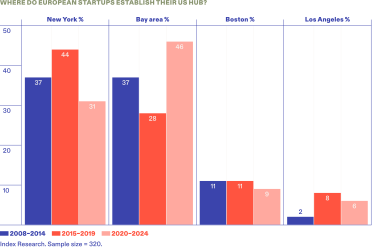
Our analysis revealed two clear winners when it came to choice of US hub: the Bay Area and New York. Despite predictions of Silicon Valley’s decline during the pandemic, our latest research shows it’s undergone a resurgence as a first choice, driven by the booming AI sector. Between 2015– 2019, it accounted for 28 percent of US hubs (behind New York), whereas between 2020–2024, it rose to 45 percent. New York now comes second, representing 30 percent of US hubs between 2020–2024, with Boston and Los Angeles trailing (if favored for specific sectors).
Following your customers is a good tenet, but qualify this not only with where your current customers are, but where your future audience is likely to be.
There are two types of customers. First, those that help you build your product. Second, the ones you are going to actually sell to.
Hannah Seal, Index Ventures
We began in Boston because we knew someone who we hired there. Then we realized most of our target customers were on the West Coast, so we moved our US center of gravity to San Francisco.
Ingo Uytdehaage, Co-CEO, Adyen
Some companies realize that their addressable market is spread across the entire US, even if their early adopters are in a specific region or sector. This is often the case with consumer propositions, or in horizontal SaaS. In this case, you might switch to availability of talent as your primary driver of where to locate.
The maxim ‘go where your customers are, and will likely be’ still holds true. If they are everywhere, then go to where it is easy to create a sales base, or create distributed teams in locations where it is easy to hire from other companies with relevant experience.
Abakar Saidov, Co-founder and CEO, Beamery
When it comes to experienced executive-level talent, critical mass tends to exist in either the Bay Area, New York, or Boston. For SaaS roles— including VP of Sales, CRO, CMO or CFO— approximately 60 percent are found in the Bay Area, with 20 percent in New York and 10 percent in Greater Boston. The remaining 10 percent are spread elsewhere. For B2C executives, the split is different—approximately 60 percent in the San Francisco Bay Area, 25 percent in New York, and 15 percent elsewhere.
If I were rating the concentration of B2B leadership talent, the Bay Area is a 10, New York is a seven, and Boston is a five.
Mannie Gill, Co-founder and Partner, Renovata & Partners
San Francisco
In 2021, it sort of felt like San Francisco was dead. One of our Entrepreneurs First alumni took me on a tour and it was like: ‘this building’s empty, this building’s empty.’ Then, over the last two years, I’d say everything has changed. San Francisco is so alive right now. It is very much back and full of buoyancy. And I think the magic is in the air here: the culture, the pace, the speed of learning, and the speed of access to really high profile people.
Alice Bentinck, Co-founder and CEO, Entrepreneurs First
As the beating heart of the AI innovation wave and the tech sector as a whole, Silicon Valley would appear to be the obvious destination for any tech company looking to succeed in the US. It offers early-adopting customers (consumers, startups, and corporates), pivotal distribution, and product partners, the most seasoned talent pool when it comes to successful scaling, and a roll call of the most successful VC funds.
Here are just a few examples of San Francisco serendipity: I got to know the Anthropic founders at a hackathon and got early access to the model. I worked with someone at Google who was now on the ChatGPT project. I got to know the founders of Notion on a hiking trip.
Raza Habib, Co-founder and CEO, Humanloop
There is a gravity to the Bay Area, an underground infrastructure: by being there, you are plugged into what’s happening, and what is on the horizon. You can’t get this anywhere else. There’s also a feeling of closeness and community in the people you are interacting with.
David Helgason, Co-founder and former CEO, Unity Technologies
If you’re building a global company, you need to know what good looks like and what the global maximum is, and that’s in San Francisco.
Alice Bentinck, Co-founder and CEO, Entrepreneurs First
However, the Bay Area presents significant challenges. The nine-hour time difference with Europe creates minimal overlap in working hours, straining communication and collaboration. This barrier to effective team communication and collaboration should not be underestimated. The additional three-hour window from the East Coast is very significant. Add to this the increased flight times and jet lag for the West Coast, which will take their toll when you’re making the trip every month or two.
Only go to San Francisco if you are selling to customers based in San Francisco. The time difference is huge, making the East Coast a lot easier for a US beachhead.
Abakar Saidov, Co-founder and CEO, Beamery
Because of timezones, having people in San Francisco working with Europe can be very dysfunctional. In San Francisco, even if you wake up at 5:00 a.m., it is already 2:00 p.m. in Europe. It becomes very difficult. Even Central Time is stretching it. You can have people in San Francisco if they mostly work with people in New York.
Julien Launay, Co-founder and CEO, Adaptive ML
The second issue is talent attraction and retention. It might be that you need specialized skills, particularly in AI and ML, that are concentrated in the Bay Area. But Silicon Valley is hyper competitive when it comes to talent, and as an outsider you might struggle in terms of brand awareness and credibility. It’s even more brutal when it comes to retention: average tenure is under two years and annual turnover rates approach 30 percent, compared to 20 percent elsewhere in the US and 10–15 percent in Europe. Expectations in terms of compensation, benefits, and sustained hypergrowth are high. You need to be realistic about whether you will be able to hire and retain A-players, as an outsider in the world’s most competitive talent ecosystem.
In San Francisco everyone feels underpaid, all the time. However, how do you quantify the benefits of being embedded in the local ecosystem where your competitors are?
Anonymous European founder
Hiring is extremely competitive in the Bay Area. You might do better in the East Coast, Boston in particular.
Andrey Khusid, Founder and CEO, Miro
The third factor is customers. Who are you selling to? It might be that most of your customers are not located in the Bay Area, in which case it might make more sense for you to establish your US hub elsewhere in order to be closer to your current and potential customers.
It is important to understand as a European founder that although Silicon Valley is a magical place, it doesn’t mean it is the right landing place for every startup from Europe. When you expand to the US, pick the location of your first employees based on where your most important customers are.
Mårten Mickos, former CEO, MySQL
At the time, I chose to hire all my US GTM executives on the West Coast. But, with hindsight, I think the East Coast may have been better with the time difference. The question is who you’re selling to. If you’re selling to tech companies, go to the Bay Area. But if you’re selling to different industries, like finance, professional services, etc., you don’t necessarily need to be there. Now, the majority of our GTM leadership is in the East Coast and in the middle of the US.
Andrey Khusid, Founder and CEO, Miro
Therefore, in practice, we only recommend San Francisco as your US hub if you are focused on AI/ML innovation, or are selling primarily either to tech companies or developers. For example, infrastructure, data/analytics, and open source software all require a focus on developer relations, have highly technical sales processes, and rely on partnerships or integrations with other software platforms. Alternatively, if you are a consumer app dependent upon distribution through the Apple, Android, or Meta ecosystems, Silicon Valley might also be compelling—although these companies now have sizable partnership teams in Europe, which is changing the dynamic.
If you don’t fall into either of these categories, we advise against choosing San Francisco as your hub. And even if you do, be prepared to establish a secondary hub as you scale, for building more operational rather than strategic teams.
CASE STUDY


-
Balanced between two AI epicenters.
-
About
Humanloop helps companies build and deploy better AI models through human feedback and oversight.
-
Founding
London, 2020
-
Founder(s)
Raza Habib, Co-founder and CEO;
Jordan Burgess, Co-founder and CPO;
Peter Hayes, Co-founder and CTO -
Founder location
Raza Habib and Jordan Burgess in San Francisco, Peter Hayes in the UK
-
Fundraising up to date
$2.8 million, seed
-
GTM
Product-led growth with enterprise sales
-
Headcount
10+ employees globally (67% Europe, 33% US)
-
Leadership
Split between London and San Francisco
-
Engineering
Primarily in London
-
US % of TAM
>50%
-
US % of revenue
75%
Origins in London’s AI ecosystem
We’re supplying picks and shovels in a gold rush, enabling the safe and swift adoption of AI across the global economy.
Peter Hayes, Co-founder and CTO, Humanloop
Humanloop emerged as a spin-out from University College London (UCL) in 2020, bringing together an exceptional founding team with deep expertise in ML and AI. CTO Peter Hayes studied pure mathematics before completing a PhD at UCL in probabilistic deep learning, where he met co-founder Raza Habib (CEO). The third co-founder, Jordan Burgess, joined from Amazon Alexa.
Humanloop was tackling the problem of how to help humans train and improve AI models—a process that typically involved huge datasets, and took vast amounts of time and money to be effective. Seeing the coming wave of large language models, Humanloop developed technology to easily evaluate the performance of AI products and agents, letting developers build more reliable products and improve them.
Global ambitions
From its earliest days, the majority of Humanloop’s customers were in the US. Founded in the pandemic, the team had the advantage of being comfortable with remote work from the start. Once COVID-19 restrictions eased, they maintained an office presence in London’s Farringdon district, where the engineering team now works three days a week.
The pull of San Francisco
Towards the end of 2023, the team decided to establish a San Francisco office. In this way, they were positioning themselves to straddle the two centers of global excellence for AI. London offered exceptional research talent thanks to the gravity well of talent created by Google DeepMind. But San Francisco provided unique access to a wider commercial AI ecosystem, with Open AI and Anthropic headquartered there. The West Coast engineering culture had an edge in applied AI, as opposed to the more research-centric approach in the UK.
There is more bias to building product with AI in San Francisco.
Raza Habib, Co-founder and CEO, Humanloop
Humanloop decided to make the most of both talent hubs by embracing different working styles in each location. They straddled the timezone by starting their San Francisco workdays super early, catching the end of the London day. In London they adopted a hybrid remote/in-person approach, optimized for engineering deep work, while at their office in San Francisco’s Mission District, they opted for a fully in-office culture to maximize collaboration and creativity.
Maintaining dual locations has added complexity and cost, including higher salaries and visa expenses in San Francisco. But the team views it as a strategic necessity. The density of brilliant operators, investors and individual contributors in San Francisco increased the number of chance encounters that created opportunities—be that a conversation in a cafe, a coworking space or a casual hike.
Nonetheless, Raza acknowledges that the full impact of the San Francisco investment remains to be seen:
I’ll be honest, San Francisco feels like a bet. The payoff is unclear and I can’t tell you yet if it is worth it. But there are these social connections and serendipity that make it feel like it’s going to work out. It is a statistical argument, based on how many generational companies have been built within a few miles of San Francisco. There must be structural reasons, but I don’t have to know those reasons.
Raza Habib, Co-founder and CEO, Humanloop
Raza’s top tips for winning in the US
- Consider being in both major AI hubs if you’re building an AI company.
- Leverage accelerators like Y Combinator to build initial US networks.
- Be prepared for significant costs when establishing San Francisco presence.
- Embrace different working cultures across locations.
- Start days early to maximize timezone overlap.
New York
New York benefits from a more manageable five-hour time difference with Europe. Its business culture is also more aligned with European norms and it has a deep talent pool across multiple industries, including financial services, media, healthcare, and fashion. New York has huge appeal as a place to live and work, particularly for younger talent, as well as excellent universities. Its earlier strengths in consumer tech (Tumblr, Etsy, Warby Parker, Glossier, ClassPass,WeWork) are now being balanced out in B2B and SaaS (MongoDB, Datadog, Squarespace, Braze) as well as fintech and health (Ramp, Headway, Nourish).
If you don’t need to be in Silicon Valley, go to New York. We picked San Francisco for the ecosystem, because we’re an API business. But the timezone is VERY tough. On the other hand, San Francisco is better for kids, and the outdoors.
Nicolas Dessaigne, Co-founder and former CEO, Algolia
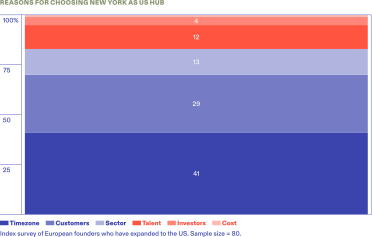
New York has become a hot spot for US HQ for European companies. The time difference and travel to Europe is far better than the West Coast, and the talent pool is growing (though smaller than Silicon Valley).
Jamie Tilotta Green, Partner, The Cole Group
If you are in a sector reflective of New York’s strengths, it’s the obvious choice for your US hub. For many enterprise SaaS companies, financial services represent their single most important customer sector. On the consumer side too, New York (together with Los Angeles) is the largest, wealthiest, and most influential US city.
It’s now possible to build entire GTM teams in New York, particularly with strong CMOs and marketing talent, given the city’s heritage. However, on the sales side, you need to be open to step-up candidates, given the relative immaturity of this talent pool and high demand.
Do be prepared for the fact that cost of living and operational expenses remain high in New York. What often surprises European founders is the intense pace and expectations of New York business culture—in many ways more demanding than Silicon Valley’s more casual atmosphere. Interestingly, our 2019 research uncovered that startups born in London are particularly likely to choose New York as their US hub (52 percent), compared to startups from elsewhere in Europe (34 percent). This partially reflects sectors, but it also appears to be a cultural choice.
London is New York’s twin.
Hannah Seal, Index Ventures
CASE STUDY


-
Building an AI community platform between Paris and New York.
-
About
Hugging Face is the platform where the ML community collaborates to build AI models, datasets, and applications.
-
Founding
2016
-
Founder(s)
Clement Delangue, Co-founder and CEO;
Julien Chaumond, Co-founder and CTO;
Thomas Wolf, Co-founder and CSO -
Founder location
Clement Delangue in New York, Thomas Wolf in Amsterdam, and Julien Chaumond in Paris
-
Fundraising up to date
$396 million, series D
-
Leadership team
Distributed globally between the US and Europe
-
Engineering
Primarily in Europe, with the largest hub in Paris
-
Headcount
250 employees globally (over 50% Europe)
-
GTM
Open-source community-driven platform with enterprise partnerships and cloud integrations
Founded in 2016 by French entrepreneurs Clément Delangue, Julien Chaumond, and Thomas Wolf, the initial concept for Hugging Face was a fun, conversational chatbot for teenagers. As a consumer project with no short-term path to monetization, the founders decided they had a better chance of raising from US investors and that the US market would be critical to their success. Rather than starting in Europe and later expanding westward, the founders decided to establish a US presence in Brooklyn, New York City, from the get-go. Clément and Julien were already in New York, having participated in the Betaworks accelerator program, while Thomas stayed in Paris to establish an engineering hub.
Pivot and growth (2018)
A few years after founding, Hugging Face began to share the app’s underlying code free online, which caught the attention of the AI community of researchers and developers. Now, Hugging Face has become the go-to platform for ready-to-use machine-learning models, allowing users to build, train, and deploy AI models.
We were a US company started by three French founders.
Thomas Wolf, Co-founder and CSO, Hugging Face [TW]
The founders’ hunch that European investors would not invest in their initial product held true at the start. The company raised additional funding rounds in the US and closed enterprise contracts with major AI companies like Nvidia, Amazon, and Microsoft, which now account for a significant proportion of their revenues.
A European edge
A key early advantage was the French tech diaspora in the US. Hugging Face found that their European heritage opened doors; the French tech community in particular has built strong networks in the US, though this pattern holds true for several European nationalities.
You have this network of people that are ready to hear you, even if your story is not fully crystallized. The French ecosystem is very good in the US.
TW
Hugging Face also leaned into their mission as a way of attracting and retaining top talent. The founders believe the open-source vision of the company has some links to European values that downplay individualism and emphasize the importance of community and collective flourishing. This ethos has helped Hugging Face find exceptional and loyal employees to fuel their growth.
Maybe it’s a consequence of European philosophy that sometimes the mission of what you’re building is more important than the business. That makes it easy to build great teams that are excited. Many people at Hugging Face could earn a lot more money at places like Google, but they really believe in the open-source mission.
TW
Distributing talent post-COVID-19
I see a lot of smaller European teams taking a lean approach to US expansion now—maybe you launch in the US with a founder and a couple of salespeople, but you build a multicultural technical team in Europe.
TW
After the pandemic, Hugging Face has evolved toward a distributed model that plays to the strengths of different regions. Many people left New York during COVID-19, which gave the company an opportunity to rethink their talent strategy. They still think boots on the ground in the US is vital to build and maintain relationships in enterprise sales, but now have a large European technical team, which helps control salary costs and improve retention. Of their 250 employees, their biggest office is in Paris, with around 90 people, and another 50 are spread across Europe.
Especially in times of political turmoil, Hugging Face found it helpful to avoid a single center of gravity—allowing them to flex according to wherever is more advantageous and stable. While there’s a lot of uncertainty about visas in the US under the Trump administration, it’s currently quite easy to get visas to bring people to France. That has allowed Hugging Face to build a world-class technical team, while avoiding some of the skyrocketing costs of US engineers’ salaries. The Paris office also benefits from being highly international, with over 20 nationalities represented.
Having a foot on both sides gives you a little bit of stability when it comes to regulation and policy. We’re not too worried about US-China tensions, for example, as we can flex our team according to circumstance.
TW
As an open-source community business, the Hugging Face founders now see geographic location as less relevant, and believe it’s possible to build credibility for a globally significant open-source business from just about anywhere. It’s also easier to raise money in Europe than it used to be, and you don’t necessarily need to even incorporate in the US anymore to tackle the market.
Interestingly, open source is maybe one of the least geographically impacted fields; it’s one of these domains where you can actually start from everywhere and be taken seriously.
TW
Thomas’ top tips for winning in the US
- The diaspora advantage: European founders can leverage their heritage and existing networks as an advantage in US expansion.
- Engineering talent arbitrage: Post-COVID-19, building engineering teams in Europe can offer both cost and retention advantages.
- Mission as differentiator: European values around collective benefit can be a powerful tool for attracting and retaining talent.
- Balanced presence: While many functions can be distributed, maintaining some physical presence remains valuable for enterprise sales.
- Timezone management: Focus on making timezone overlaps work rather than geographic co-location.
Boston
Boston offers a unique combination of deep technical talent, strong enterprise presence, and quality of life. The city’s heritage in enterprise software, combined with its strength in life sciences and academia, creates a fertile environment for B2B companies. The presence of MIT and Harvard provides access to cutting-edge research talent in areas including robotics, biotech, and enterprise software. Notable Boston B2B and SaaS success stories include Hubspot, Mimecast, Akamai, Datarobot, Fuze, Toast, and Salsify. Snyk is a more recent B2B example.
Highway 128 is the Silicon Valley of the East. Boston is a college town that feeds this. New York isn’t. It is focused on finance, media, fashion.
Mary Beth Vassallo, former VP and GM North America, Nexthink
In lifestyle terms too, particularly for families, it compares favorably against New York, with shorter commute times and access to nature. Housing costs and salaries run about 20 percent below New York, while employee retention tends to be significantly better than either San Francisco or New York.
Boston is a city where you can have a normalized family life, which is critical as a founder giving so much time to your business. You can commute in 30 minutes, and have a good lifestyle. Your money won’t go far in New York or San Francisco.
Peter Bauer, Co-founder and former CEO, Mimecast
If you go to Boston, you will face a difficult choice between locating yourself downtown in the city where you will find many of the younger startups—or in the Western suburbs, home to more mature tech companies. This situation mirrors, but trails, the evolution of the Bay Area, with the rise of San Francisco as a startup city, in contrast to the campuses of the tech giants along highway 101 to the South.
I’d caution against setting up downtown. It’s appealing for junior hires, but most of the experienced talent is to the West, and they don’t want to commute.
Peter Bauer, Co-founder and former CEO, Mimecast
CASE STUDY

-
The power of early US customers.
-
About
incident.io helps teams manage incidents, streamline communications, and learn from their mistakes.
-
Founding
London, 2020
-
Founder(s)
Stephen Whitworth, Co-founder and CEO;
Pete Hamilton, Co-founder and CTO;
Chris Evans, Co-founder and CPO -
Founder location
Stephen Whitworth in New York
-
Fundraising up to date
$33.4 million, series A
-
GTM
Predominantly sales-led motion
-
Headcount
80 employees globally (67% UK, 31% US, 2% RoW)
-
Leadership
Primarily London
-
Engineering
London
-
US % of TAM
>50%
-
US %of revenue
75%
The call of the US
incident.io was born out of the founders’ experiences at Monzo, where they saw firsthand how critical efficient incident management is for tech companies. Their platform helps teams respond to technical incidents and outages more effectively by automating key workflows, ensuring clear communication channels, and capturing insights that help prevent future problems.
The founding team of three launched incident.io in March 2021, and went full-time in July. They experienced unusual US market demand from the company’s earliest days. Even while still a side project, they saw strong US interest, with around 700 people signing up to hear more. When analyzing their initial customer base, they found that three-quarters were from the US.
This organic US pull stood in stark contrast to Co-founder and CEO Stephen Whitworth’s previous experiences at Hailo, Ravelin and Monzo, where European companies had to push their way into the US market.
With incident.io, we had US customer pull from day one. We had a landing page, Twitter account, LinkedIn, and content marketing which was working well. As a result we had a real opportunity to expand to the US.
Stephen Whitworth, Co-founder and CEO, incident.io [SW]
Land grab
The team recognized both the opportunities and risks in having a strong US presence. Along with the bulk of their customers, 75 percent of their revenue comes from the US, and 75 percent of that from the West Coast. However, they were concerned that not having boots on the ground could create an opening for competitors, particularly those based in Silicon Valley, New York, and Canada. The team knew being close to customers was critical, particularly given the late-night calls they were already taking with US customers.
Being close to customers and being more of a ‘US native co’ seemed the right move for us.
SW
As three product and engineering co-founders, they were also attracted by the strength of the US GTM talent pool. When they hit $1 million in recurring revenue, a team of 20–35 people, and were raising a series A, they were prepared to make bigger bets.
Let’s be American
Stephen made the jump to the US in January 2023. They decided to keep Product and Engineering in London, leveraging their strong network and the significantly lower costs—around half that of the US. But Stephen’s move as CEO showed commitment to attracting the best talent.
We decided we were going to commit fully to this US expansion. We were taking a cutting of the plant to America, and were going to plant it there to be properly American.
SW
They chose New York primarily for the timezone advantages, gaining 2–3 times more overlap time with London compared to San Francisco. They also factored in the city’s trajectory: making the decision pre-AI boom, they saw New York as ascendant.
However, with hindsight, Stephen notes some challenges with the New York location:
- While good for hiring AEs, customer success managers (CSMs), Managers and Directors, it was hard to find VP or senior leadership talent. Many were located on the West Coast.
- It’s harder to get people to relocate to New York compared to San Francisco.
- New York feels a bit like a “playground for 20-30-somethings.”
New York is marmite—either you love it or hate it. If I were in fashion or beauty, New York would make sense. But if I were to do this again, it would be San Francisco. It would require you to get up at 2:00 a.m. versus 5:00 a.m., but it is very different.
SW
Growing the team
The company learned several key lessons about hiring and team structure:
- Landing team and culture: One early realization was that having a larger landing team, with more individual contributors, could have helped to seed the culture more effectively.
- GTM talent reality check: The team quickly had to adjust their expectations about US GTM talent. Despite the depth of the US talent pool, finding the right fits proved challenging.
I think I was enamored by the idea that all GTM talent in the US would be incredible.
SW
- Secondary cities vs. coastal hubs: They initially hired leaders where they could find them: a VP CS in San Francisco, Sales leader in North Carolina, and Marketing leader in Boston. This distributed approach proved challenging, with leaders that did not work out and other candidates unwilling to travel as frequently as Stephen expected.
It was painted to me that salespeople are always on planes or trains. In our experience, people will do it 1–2 times a quarter but no more. So, looking back, I would have only chosen leaders in San Francisco or New York. The reason this feels hard is that, in the UK, the only place that really matters is London—so if you are looking for top talent, it is likely they will be in London. But in the US, there are lots of Londons. There are more people, more economically developed zones. But looking back, I wouldn’t have compromised.
SW
- The importance of office culture: The team came to appreciate the value of having a physical hub where team members regularly interacted, which proved invaluable for building cohesion and maintaining culture. This happened in London, but was harder to build in New York.
Building brand and GTM
incident.io has found that in-person meetings represent only about 5 percent of their deals now, with most sales happening via Zoom. They’ve successfully built a strong mid-market commercial customer base, with ARR north of $10 million, including enterprise customers like Netflix.
However, they recognize the importance of brand building, particularly in San Francisco, to become “the new default for startups and digital natives.” This has become one of their first strategic priorities. In line with this, towards the end of 2024, Stephen announced the opening of their San Francisco office in early 2025, led by their new San Francisco-based CRO, with other founders relocating to support. This move will position the company closer to its current and prospective customers, most of whom are located in the Bay Area.
The key learning has been about commitment level:
If you are doing the US, commit fully and don’t compromise.
SW
Secondary hubs
As your US footprint grows, it often makes sense to establish a secondary hub in a lower-cost location for your support functions. Typically these might include SDRs, inside sales, customer support, and operations (billing, compliance checking, etc.). This has become part of the playbook for domestic US startups in recent years too, and a large number of secondary cities have emerged as potential destinations.
The decision to establish a secondary hub typically comes into play when support functions reach 50+ people or when 24/7 coverage becomes essential. Popular secondary locations include Denver, Austin, Atlanta, and Tampa, each offering distinct advantages ranging from cost, to talent retention, to time difference with London. Other options might be Phoenix, Raleigh-Durham, Dallas, Columbus, or Nashville. Startups born in Europe will be particularly focused on nationwide office-hours coverage for sales and support functions, so tend to cluster in cities on Central and Mountain Time. Another significant factor specific to European startups is the availability of direct (or at least straightforward) flights to their European base, as well as within the US itself.
Opening a secondary hub can carry more risk the earlier it is done, since it extends multi-office challenges around communication, culture, and management. However, this needs to be offset against the challenge and cost of hiring and, in particular, retaining large, often junior and lower-paid teams. This can be brutal in New York or San Francisco, although somewhat easier in Boston, where cost and talent competition aren’t quite as intense.
In [secondary hubs], people think ‘This is a great place to work’ and are happy. In San Francisco, people are more like: ‘Where is my barista?’ It’s much harder to retain people.
Anonymous European founder
The precise trade-off in timing will vary, driven in particular by your team’s functional makeup. If your model is support- and ops-intensive from the start, a secondary hub is likely to make sense sooner. Over time, the secondary hub may well become your largest single US location. While these cities can be strong on junior- and mid-level talent in certain functions, they will be weaker when it comes to marketing or business development, and it is very unlikely that they can provide you with executive-level leadership. So you will have a continued need for a primary hub in one of the four core cities.
Buyers don’t care where in the US you are, so long as you have presence and a story.
Joel Passen, former Head of Global Sales, Beamery
CASE STUDY


-
Conquering the cross-currency market from New York and Tampa.
-
About
Wise is building the best way for people and businesses to move money around the world.
-
Founding
London and Tallinn, 2011
-
Founder(s)
Kristo Käärmann, Co-founder and CEO;
Taavet Hinrikus, Co-founder and former CEO -
Founder location
UK
-
Listing
2021 in London Stock Exchange (LSE)
-
Fundraising up to listing
$396 million, series E
-
GTM
Primarily mobile app platforms
-
Headcount
5,500+ employees globally
-
Leadership
Primarily in the UK
-
Engineering
Primarily in Europe
Context for US expansion
Kristo and Taavet knew from the outset that the US was the single biggest market for cross-currency payments. Roger Ehrenberg from IA ventures, one of their earliest investors, was also based in New York.
The company had already built coverage across the EU (both Eurozone and non-Eurozone), as well as Norway and Switzerland. However, they knew the US would be different: to meet the scale of the opportunity, they’d need to build a dedicated, full-stack, local team.
Regulation
Allowing customers to send money to a country is the less complex side of the equation in money transfer, and Wise had this live for the US as an MVP by early 2014. Enabling customers to move money out is much harder, and involves navigating a far tougher regulatory environment. In December 2014, following their $25 million series B led by Valar Ventures (New York-based fund), Wise launched this service, leveraging US licensing [JC5] partners to enable speed to market. It worked, but there were challenges, such as when a certain US state’s regulator wasn’t happy with the process used by Wise’s banking partner. They had to move quickly to set up a replacement.
Operating from Europe and using partners in the US was challenging. But it gave us the speed we needed to help serve our customers far earlier than we otherwise would have been able to.
Joe Cross, initial GM USA, Wise [JC]
Securing their own licenses took nearly two additional years. Although users would hardly notice the change at first, it was a major back-end logistical challenge. US regulators required locally-based Wise employees, and each state had its own regime.
Our compliance team had to do a roadshow to loads of states, pitching them for regulatory approval. It made me realize that the US really isn’t a simple, single market. In the EU, fintech businesses like ours only require a single license to operate across the whole bloc.
JC
I had to get my fingerprints taken 50 times in a police office in downtown New York, so that all states could verify my identity.
JC
Launch team
Setting up the US involved a trade-off between local knowledge (US hire) and culture fit (transplant from Europe). The leadership thought hard about it, and decided to send a landing team for culture fit, who could then hire for local knowledge.
Joe Cross, head of marketing, and employee #12 at Wise, led the landing team as GM, and moved to New York in January 2015 together with Henrik, who led the product element of the team. In parallel, the head of customer support moved from Tallinn (Estonia) to Tampa (Florida), to build a local CS team.
I felt like I was stretching the organization to America, hiring the specialist people who needed to be there.
JC
US locations: New York and Tampa
New York was the obvious choice as the hub, given the fintech angle, plus timezone. It has a rich and deep immigrant history and is full of international communities, who are Wise’s core demographics. Initially, they focused on expat networks of Brits, Europeans, and Australians. While the LaTam opportunity in the US was bigger, the company wasn’t live there yet.
Tampa proved to be a great choice for support and payment operations, with many universities, and several corporates running ops centers. This provided a large talent pool. The larger portion of the US team is now there. It was also a great location to service LaTam, given the large community of Spanish speakers. The mayor of Tampa was extremely helpful. The Wise office is in an old cigar factory, and they held a launch event just as Donald Trump was coming into office. The Democratic mayor opened the site, exclaiming how happy Cuban factory workers would have been about this immigrant-supporting company.
US tech
Originally there was a product and engineering team in Tallinn focused on US and Americas localization. But over time, it became clear that the US needed its own local tech team. Some engineers relocated to New York, and there have now been many local hires too.
They had a US flag above their desk in Tallinn, and one team member played weekly renditions of the Star Spangled Banner on the guitar!
JC
There was a lot of stuff we needed the central team to do, and it wasn’t always clear to them why we needed it.
JC
Culture
The US team found it easy to get behind Wise US, but harder to feel allegiance to the global brand.
We wanted [then] Wise to be a distributed global team: one team with a unifying mission. This is so much more powerful than individual country units.
JC
When Joe returned to the UK in 2016 after two years in New York, a local GM replacement wasn’t hired. Instead, they reintegrated the US teams into global functions. Over this period, Wise had hired and developed a strong slate of functional leaders based in London and Tallinn, including seasoned executives who relocated from the US.
The company holds an annual week-long summer offsite in Estonia, for which some US team members got passports to leave the US for the first time. This worked well for bonding, although some people were jet-lagged and experienced culture-shock. What worked even better was when people from European offices did stints in the US for a week or so, to help with onboarding new US hires.
Florida and Estonia are very far apart from a cultural perspective, but there were things that worked very well. For example, they made sure that CS agents in Tallinn learnt American banking lingo and terminology. On the Florida side, many of the CS agents joined from more traditional corporates. They now found themselves being quizzed by the Estonian engineering team for customer insights to improve the product, and they loved being involved.
Marketing
Ahead of expansion, Wise analyzed census data, to prioritize how to tackle the US. They looked at the percentage of foreign-born residents, as a strong indicator that someone would use their service. New York, California, and Florida came out top.
You can get scared of how large it is, and not sure where to start. But it isn’t one big monolithic market.
JC
The US had good word-of-mouth (WoM) growth, but the viral coefficient was not the same as in the UK. The team needed to do paid marketing, as well as a PR drive.
WoM has nothing to do with how big a country is: it doesn’t mean that people know more people (except in Brazil!), so the viral loop is not enhanced.
JC
Wise didn’t realize how challenging it would be to stand out in New York, given the numerous homegrown fintech companies competing for consumer attention. They had to cleverly use paid social media to find pockets of customers. They also ran subway ads in New York for a number of years, which was good for brand awareness, as well as for hiring and team morale, and was ROI-neutral in terms of trackable customer acquisition. Podcast sponsorship also became a major marketing channel.
As the US footprint expanded, they analyzed census data in terms of nationalities-by-area, to prioritize which LaTam corridors to open up, and where to focus local US marketing efforts for specific LaTam communities.
For PR, sharing what was happening in European banking was interesting for tech and business reporters at major media brands: Wall Street Journal, New York Times, The Economist, and Reuters. These were important outlets for credibility and brand. Wise business announcements are now usually covered in the US. However, leveraging the reach of consumer media has proved much harder.
There’s such a cultural difference! US consumers are surprised by instant transfers, whilst Estonians ask ‘what’s a check?
JC
US network-building
You’re best placed to succeed by starting your company in the place where you have the strongest network and support in order to secure critical early hires and investors. It would be a recipe for disaster to move to the US to start your business there, without having first established an initial US network. For founders moving to the US early on in their journey, immigrant networks can prove to be a valuable asset (e.g., Hugging Face). Alternatively, university programs or transfers are a good way to build connections (e.g., Duolingo). US investors or well-connected executive hires can also be the key to building a strong network in the US. Joining a community like “Europeans of New York” run by Index’s Martin Mignot, or GBx (network for successful British entrepreneurs, investors, and senior British tech executives, in the Bay Area) in San Francisco is a good way to get plugged into the local ecosystem.
If you have a strong US network as a founding team, and your TAM is clearly weighted to the US, building the company in the US from either day one or from pre-seed onwards can make a lot of sense for you. In this case, it is better for the entire founding team to move over, following our Transplant archetype.
If your TAM is weighted to the US, but you do not have a pre-existing US network through work experience or university, applying to Y Combinator or one of the other top accelerator programs in the Bay Area, such as AI Grant, South Park Commons, Neo or Pear, is a good route to go.
An accelerator can be a great tool to quickly build a strong network of other founders, talent, and potential customers in the US, even if your plans to enter the US market are much further down the road.
Nina Achadjian, Index Ventures
Several European success stories are Y Combinator alumni:
- Stripe. Stripe was founded by the Collison brothers who are Irish, but the company was built in the US. The latest funding round in 2024 by Sequoia brought Stripe’s valuation to $70 billion.
- Front. A unicorn company out of Paris. Its series D in 2022 was led by Salesforce and Battery Ventures, including participation from Sequoia who led their series B.
- Algolia. San Francisco-based company founded in Paris by French entrepreneurs. Raised series D in 2021 from investors like Accel and Salesforce Ventures.
- Duffel. Founded in London. Raised series B in 2019 led by Index with participation from Benchmark and Blossom Capital.
- GoCardless. Founded in London. Series G in 2022 brought the valuation to $2 billion.
- Bird. Founded and headquartered in Amsterdam. Series C in 2021 from funds like Accel and Spark Capital brought the company’s valuation to $3.8 billion.
More recent examples include Humanloop, Photoroom, Leya, Lightdash, and SolarMente. In addition to helping European founders with refining their product offering, Y Combinator offers its alumni a deep network of advisors, investors, and talent.
Distributed leadership teams
Building a successful transatlantic business implies that the company’s leadership will eventually be distributed across continents for at least some functions or some time period. This presents challenges, even for companies with a fully remote model. The critical factors to ensure success with a distributed leadership team is a willingness to travel and meet frequently, as well as doing some out-of-hours meetings. This is essential for any executive in an organization split between the US and Europe, and the expectation needs to be explicit before making any hire.
We found our VP Sales, Ethan Schechter, in Boston through an executive search firm. In hindsight, it was a high-risk hire—he was remote, with no prior connection to my network. But it worked out incredibly well. The key repeatable element was that I had daily conversations with him for a good while to build trust. He was a workhorse: he worked long hours, woke up early, and was incredibly effective.
Guy Podjarny, Co-founder and former CEO, Snyk, and Co-founder and CEO, Tessl
I was focused on getting the best talent, so I accepted the trade-offs in having a distributed leadership team: management tension, lots of travel, and video conferencing. I can recommend this when you are in pure scaling mode, and when the proposition is totally clear. But not at the stage when you are changing things, and adding product lines, all the time.
Jean-Baptiste Rudelle, Co-founder and former CEO, Criteo
At the earlier stages, it’s important that leaders are co-located with their functional team, until there’s sufficient bench strength to cover day-to-day management. We see this most clearly with R&D leadership––engineering and product leadership will remain in Europe for several years, before it is possible to consider upleveling these roles in the US. But the recommendation applies to other functions too, such as marketing, finance, and operations. When a functional team is small, there is a significant advantage to co-location. It is easier to establish systems and processes, and to train up more junior members of staff.
We learned that having 40 people in London being led by someone on the West Coast is super challenging. We try and keep more of a balance now. If you have a bit of everything everywhere, then all of a sudden, you’ve got people shoulder to shoulder, good knowledge sharing, and good distribution of ideas. But having everyone on one side and the leader on the other side can be really tough when it comes to efficiency and speed.
Alex Kendall, Co-founder and CEO, Wayve
Sales leaders in companies with a field sales model are an exception to the co-location model. Field sales teams, once you start scaling, are likely to be distributed by nature, and also composed of experienced individuals, so it is fairly common for these roles to be remote. That being said, it is still preferable if sales leaders are located with other leaders.
US exposure via Y Combinator: Algolia
I didn’t hesitate. And in the meantime, I traveled to the US a lot. I acted as if I was already here, and developed muscle for working at a distance.Nicolas Dessaigne, Co-founder and former CEO, Algolia
For European startups looking to break into the US market, accelerator programs can provide invaluable exposure and networks. Algolia’s journey through Y Combinator offers interesting lessons about timing and trade-offs.
Founded in Paris in 2012, Algolia took an unusual path to YC. Unlike most participants who join at the earliest stages, Algolia had already raised seed funding (including from Index) and built a six-person team when they joined the Winter 2014 batch. While the additional dilution gave them pause, the founders saw Y Combinator as a strategic bridge to the US market.
The experience validated their thesis, but also surfaced complex decisions about geographic strategy. Post-YC, the team debated relocating everyone to San Francisco. However, with one co-founder expecting a child and a strong desire to keep the team unified, they initially chose to return to Paris.
The company did make structural changes, converting to a US parent company as required by YC. While this created some complications around French stock options (BSPCEs) and taxes, it positioned them better for future US operations.
Rather than making an immediate wholesale move, co-founder Nicolas Dessaigne took a more gradual approach, traveling frequently and operating as if he were already in the US. By 2015, when the US represented 50 percent of revenue, he formally relocated to San Francisco.
The choice of San Francisco over New York was driven by Algolia’s developer-focused API business, which required deep ecosystem engagement. The company found creative ways to manage the costs of establishing a presence—starting with a shared apartment and progressively upgrading as the business grew.
Algolia’s path shows how accelerators can provide a valuable foothold in the US market while still allowing companies to chart their own course on timing and execution of a fuller expansion.
Building from Israel
The best companies born in Israel are global from the outset. With a limited domestic market, and an ecosystem particularly strong in enterprise software, Israeli companies have learnt to build global companies from the beginning. In addition to the European-born breakthroughs, our research identified a further 27 Israeli-born breakthrough companies.
- B2B: Appsflyer, Axonius, Cato Networks, CyberArk, Fireblocks, Gong, Island, Jfrog, Melio, Monday.com, Navan, Rapyd, SentinelOne, SimilarWeb, Synk, Tipalti, Transmit Security, VAST, Wiz, Via.
- B2C: Fiverr, Lemonade, Moon Active, Outbrain, Taboola, Wix, Ironsource.
As an Israeli startup founder, you have the opportunity—perhaps even the duty—to build a global company: your chances of being able to grow a category-defining business that shapes the future are higher than ever before. With over 7,000 active startups, the highest per capita globally, and tech accounting for almost 20 percent of GDP, Israel has established itself as more than a startup nation. It’s attracting high levels of VC funding ($12 billion in 2024), and its ecosystem has diversified beyond its traditional strengths in cybersecurity and infrastructure into fintech, gaming, digital health, and AI.⁷
Today, you have advantages your predecessors didn’t. You can draw from a deep pool of experienced operators who have scaled companies globally. You have access to international capital directly in Israel. And you can learn from the playbooks of companies that have successfully built global businesses from day one. Many of the most successful Israeli companies are led by repeat founders who gained valuable experience inside US tech companies after their first exits: Dealroom estimates that 75 percent of Israeli unicorns are founded by serial entrepreneurs.
The Israeli landscape has gone through a very significant evolution in the past couple of years. We’ve been through a couple of cycles of founders building and selling their companies, returning to Israel having seen much more.
Juriaan Duizendstraal, Index Ventures
Israeli startups should strive to serve global businesses from the get-go—not least because the way Israeli customers think and behave is rarely representative of global businesses. Unlike in France, Germany, or the UK, where local enterprise customers often resemble global organizations, focusing on local customers in Israel can actually divert your product development away from the goal of building a winning global solution.
While this might mean sacrificing the pride and convenience of serving local businesses you can “run across the street” to visit, it dramatically increases your chances of long-term success. As an Israeli founder, it can be important to learn to say “no” to some low-hanging fruit, and to learn to say it early.
All the emails and all the documents have to be in English. Not because it’s easier to communicate in English, but because everyone knows in order to be a global company, you need to establish a global culture.
Alon Arvatz, Co-founder and CEO, PointFive
On your journey to building a global business, you’ll likely need to establish a strong US presence. For most Israeli founders, New York offers clear advantages over San Francisco. There are exceptions to this rule, particularly if you’re building a developer-focused company, where the San Francisco ecosystem might offer greater advantages.
But for most enterprise-focused Israeli startups, New York provides a more strategically advantageous base, for these reasons:
- Timezone compatibility: The East Coast provides more overlapping working hours with Israel, allowing for real-time collaboration between teams.
- Enterprise customers: The density of Fortune 500 companies and enterprise customers is significantly higher in the New York region.
- Talent pools: New York offers deep pools of commercial talent across sales, marketing, and customer success functions.
- Community support: A well-established Israeli business community in New York provides valuable networks and support systems.
One of the pivotal moments Israeli founders face on their scaling journey is the decision to introduce management layers. While the connection between the Israeli Defense Forces’ (IDF) compulsory military service and the startup ecosystem is well acknowledged, what’s often overlooked is how the non-hierarchical structure of the IDF contributes to a similar culture within Israeli companies.
This flat structure offers significant benefits in early stages—eliminating barriers between founders and contributors, working against internal misalignments, and ensuring team synchronization. But as companies scale, introducing a management layer becomes necessary to accelerate hiring, onboarding, and ultimately growth.
There’s often resistance to bringing on management in order to preserve a flat non-hierarchical team. However, at the right time, management can accelerate your growth.
Shardul Shah, Index Ventures
The first step is acknowledging your own potential bias against “bureaucracy.” Figuring out when to bring in managers isn’t about following a specific formula or reaching a magic number of employees; rather, it’s about making a judgment call based on your growth ambitions, ideally with input from experienced business partners who have seen this transition before.
It’s a judgment call as to when to recruit a manager, irrespective of the function. That judgment call is best made with someone who’s had experience with other companies. There’s no standard formula.
Shardul Shah, Index Ventures
Cultural integration is worth watching out for too. Israeli business culture is notably direct, which can create tension when expanding internationally. One significant pitfall for Israeli founders is accurately assessing US candidates during hiring, as they can struggle to evaluate the substance behind the polished American presentation style.
One of the pitfalls for Israeli founders is that they have a very hard time understanding and reading into US hires who are usually very good at selling themselves.
Juriaan Duizendstraal, Index Ventures
The parable of the bananas: a founder’s perspective on Israel from Guypo
Guy Podjarny (“Guypo”) built and scaled two successful startups out of Israel before launching Tessl, the AI-native software development platform.
To understand the distinctive Israeli approach to growing global companies, Guypo describes an internet meme about trying to build a banana-straightening machine. When presented with the brief, the American engineering leader is full of compliments and says it’s an excellent idea. After two weeks, she comes back with a detailed plan that would involve a four-month development process and a million dollars.
Next comes the Israeli engineer. Their response: “Who wants a straight banana? That’s ridiculous.” But they come back the next day with a different take. “OK, we’ve thought about it. Maybe there’s something there. It’s going to cost you $10,000, and we can have it ready in a week made from the spare parts from a juicer.” The solution works, but a third of the bananas are smashed, burned, or mysteriously disappear. When asked about the failures, they shrug. “You never specified it had to work for all bananas. Besides, it was a stupid idea to begin with.”
This Israeli startup approach is pragmatic, efficient and direct—something that offers a unique vantage point for global expansion, particularly to the US market. Guypo notes that Israeli founders often start with a fundamentally different mindset from many European counterparts. “Israelis never have the illusion that their market can carry them any distance—it’s too small,” Guypo says. This drives a more global orientation from day one, with founders typically targeting the US market from inception rather than trying to build domestic traction first. They face particular barriers too, including a more challenging timezone overlap with the US and the Sunday–Thursday work week—but perhaps these obstacles help drive the resilience and grit that Israeli founders are known for.
Guypo cautions against using Israeli customers as a blueprint for consumer behavior elsewhere. They can be great early adopters, as they tend to be more naturally experimental and much more direct in expressing their needs. They often have existing relationships with team members due to the ecosystem’s small size, making decisions more relationship-driven than in larger markets. But they’re not necessarily representative of consumers more broadly. Israeli customers typically push for customization and additional features, and prioritize function over design or simplicity. They’re also typically more price-sensitive and energetic at negotiating discounts. “They’re massively valuable as design partners,” Guypo explains, “but it’s dangerous to optimize your roadmap to that profile.” He advises using Israeli customers to validate early product concepts, but not letting them drive decisions about pricing, simplicity or design.
When it comes to designing a distributed organization from Israel, Guypo suggests “the base case should be if there are two founders, one moves to the US.” While some advocate for both founders relocating to the US to accelerate closing deals, Guypo believes this is short-sighted. “Nurturing your development center is as important as building your customer base,” he explains. Often in Israeli startups, both founders come from technical backgrounds, with one taking on marketing and commercial responsibilities. In these cases, if both founders do decide to relocate to the US, Guypo recommends identifying and elevating an early engineering leader who can grow beyond their functional role. The key principle remains: any location without a founder needs a true company leader who participates in company-wide decisions, not just running a team. “You need to make sure the Israeli branch doesn’t become just a software factory,” Guypo says.

What the well-dressed astronaut is wearing
When Neil Armstrong gingerly stepped on to the surface of the Moon in 1969, he had a Spaniard to thank for being able to leave the safety of Apollo 11. Lieutenant Colonel Emilio Herrera Linares was a brilliant, polymathic Spanish military engineer from Granada. In 1935, he designed and built a full-pressure suit called “escafandra estratonáutica” for an upcoming stratospheric balloon flight. Safe, maneuverable and even sporting a microphone, Herrera’s ideas were enthusiastically adopted by the Soviet space program and, later on, NASA. The 1930s suit may look clunky now, but it elegantly solved the problem of mobility by using accordion-like parts for the movable joints. And it weighed 127kg, just three kilograms more than “International Orange” suits used by NASA since 1982. In appreciation of Herrera’s work, Neil Armstrong presented a lunar rock to NASA employee Manuel Casajust Rodriguez, one of the great man’s acolytes.
Stories of Success