HIRING
As European startups increasingly build for global markets from the outset, the question shifts from “how do we expand to the US?” to “how do we build a successful transatlantic company?” This requires thoughtful decisions about leadership, team structure and geography from the earliest stages. It also requires a level of commitment to your mission, and a willingness to make sacrifices for it, that you need to be psychologically prepared for.
Lots of European companies say, ‘Oh yeah, we’re going to move next year,’ but few of them actually do it. There’s a lot of prep, there’s a lot of travel back and forth, but it’s like there’s this moving goalpost—‘I need to make this hire, I need to win this customer in Europe.’ The truth is, there’s always something else that you need to do before you’re ready. You’re never ready. At some point, you just do it.
Martin Mignot, Index Ventures
The most critical decision that determines success in the US is who leads the expansion. Our research reveals an interesting tension. 60 percent of European founders believe it’s critical for a founder to move to the US—and out of these, 60 percent believe that it should happen from the start of the expansion phase. However, only in the case of 41 percent of the companies we studied did a founder actually make the move. Even in our list of European breakthrough successes in the US, only about a third of founding CEOs moved there.
So what’s going on here? Do founders delay moving when they should, or do they simply come to realize that moving is not so critical after all? We’ll unpack some of the nuances in the next section. There are several ways to orient yourself towards expansion: how founders are distributed; who makes up the initial team; what local talent and leadership you will bring in; and how you’ll juggle distributed versus in-person work.
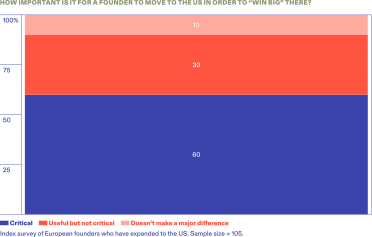
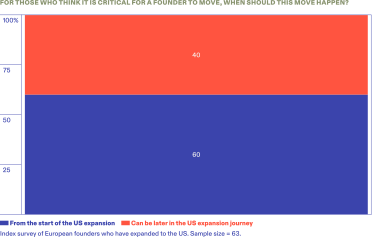
The decision to relocate is deeply personal for founders. A lot of it comes down to your family, your support network, and your quality of life, in addition to your business strategy. There’s no one-size-fits-all approach, and the best decisions come when founders are honest with themselves about what trade-offs they’re willing to make for their company’s growth.
Hannah Seal, Index Ventures
FIRST BOOTS ON THE GROUND
The type of presence you need in the US is influenced by your business model and GTM strategy. The pandemic has demonstrated that remote teams can effectively perform many functions, challenging long-held assumptions about geographic requirements.
For consumer products distributed through app stores, European companies can often succeed in the US without boots on the ground, boosted by more mature European tech ecosystems, the greater availability of European capital, and the fact platforms like Apple and Google now have strong European offices. Similarly, B2B SaaS companies born in Europe can win early remote customers via bottom-up, self-serve models targeting small and mid-market businesses. Digital-first acquisition, robust online onboarding and virtual customer support have made remote expansion more viable than ever.
I wouldn’t try to start a company focused on one geography. You should think about the work as global from the start, especially if it’s self-serve everywhere. For top-down sales, I think you do need boots on the ground, ideally people that have been there before, rather than parachuting people from here to there.
Mati Staniszewski, Co-founder and CEO, ElevenLabs
However, as companies move upmarket to enterprise sales, physical presence becomes increasingly crucial. Enterprise customers typically want to see commitment when adopting new technology—both for closing strategic deals and ensuring the features they need get put on the product roadmap. This doesn’t necessarily mean founders must relocate, but it does call for a carefully calibrated—and physically present—team to build trust and relationships. This accords with our research that customers are one of the main drivers behind transatlantic expansion.
Founder relocation: necessity or choice?
If your company does need boots on the ground, the question becomes: do they need to belong to a founder? The evidence strongly suggests that having a founder in the US maximizes your chances of success, especially if you’re a Magnet—and the earlier you move, the better. For Pendulums, it can be desirable, but not necessarily as critical, for a founder to move. The move can also be postponed until there’s clear evidence of the US becoming the company’s most important growth-driver. For Anchors and Telescopes, these archetypes can often succeed with founders remaining primarily in Europe while building strong US leadership teams and maintaining a regular presence in the market by travelling regularly. That said, there’s a tendency for Telescopes to morph into Magnets or Pendulums in pursuit of larger clients and deals, in which case the GTM strategy becomes sales-led rather than self-serve. If this happens, a founder move might again become necessary.
Europe was validated from 2019–2021 with many US VCs setting up shop in Europe and with decacorns getting built here. However, if founders have raised from US-based VCs, increasingly I do see them moving to the US. If you are selling to US tech companies, for example, it is very hard to have a commercially minded CEO who is not based there.
Mandeep Singh, Angel investor and Founder, Trouva
The dynamics of transatlantic expansion have evolved significantly since the pandemic. It’s easier than ever before to do things in a remote or distributed way; as a consequence, some Magnet founders are banking on the fact that exceptional execution and strong US leadership can compensate for a founder not being on the ground. The pandemic has also blurred the lines between archetypes, with many companies that would traditionally follow a Magnet model now operating more like Pendulums.

If you’re not moving to the US, you have to compensate for that with the type of hires you make. You need more than just functional leaders: you need company leaders. And you should invest in high-trust relationships with those individuals from the beginning, specifically with daily short conversations.
Guy Podjarny, Co-founder and former CEO, Snyk, and Co-founder and CEO, Tessl
Sometimes staying in Europe can be a strategic advantage as you maintain proximity to your engineering core. The key is having excellent leadership in the US who can autonomously drive growth.
Hannah Seal, Index Ventures
However, it’s still too early to determine whether founders of Magnet companies can seize the full scope of business opportunities through to exit without moving to the US. The truth is that we’re yet to see examples of European-born companies growing through the lifecycle without a founder fully committing to relocation. In particular, B2B companies moving upmarket into enterprise sales tend to face increasing pressure for a founder to be present, as enterprise customers typically want to see founder commitment when adopting new technology. Most European-born companies that have achieved major liquidity events did have founders move to the US at some point in their journey. As companies scale up and approach IPO or acquisition, having key C-Suite leaders in the US creates a natural gravitational pull that often draws founders to spend more time there.
Momentum won’t come as fast if you’re not here. You’ve got to show that you’re committed, to talent and to partners.
Nicolas Dessaigne, Co-founder and former CEO, Algolia
Regardless, seriously growing the transatlantic organization will call for a highly vetted and trusted US leader, who can absorb the DNA of your company and swiftly execute on expansion.
Unless you have a compelling mission and a strong existing network, you might struggle to attract the right caliber of candidate—which means it will have to fall to you or one of your co-founders, who are generally the best culture-carriers for your company and can be trusted to uphold your values and vision. A technical co-founder might continue to drive your engineering efforts in Europe while you move to the US to focus on growth, or you might swap roles with a more business-oriented co-founder.
Some people advocate for both founders to move because it helps close bigger deals. I think that’s a short-lived strategy. You need to think about the importance of nurturing your development center as much as building your customer base. Sometimes it’s doable for both to move if you have an early engineering leader who can be elevated. But otherwise it will probably make sense for someone to stay behind.
Guy Podjarny, Co-founder and former CEO, Snyk, and Co-founder and CEO, Tessl
If you’re not moving yourself, it’s nonetheless crucial to spend a lot of time there. You’ll need to commit to a lot of travel to kick off key relationships and close deals, even if you might be able to rely on others to carry things forward once you’ve created the momentum. And you should prepare for late night calls to overlap with the West Coast, where that’s relevant. Grit and intentionality can do a lot to compensate for geography, but you can’t beat timezones.
For mobile games today, I think it must be possible to build a very big business in the US just from Europe. But for enterprise SaaS, it would be very hard to imagine you could win in the US without physically being there.
Ilkka Paananen, Co-founder and CEO, Supercell
CASE STUDY
 /


-
Steering from Europe to capture the US.
-
About
Pigment is the platform where the ML community collaborates to build AI models, datasets and applications.
-
Founding
Paris, 2019
-
Founder(s)
Eléonore Crespo, Co-founder and Co-CEO; Romain Niccoli, Co-founder and Co-CEO
-
Founder location
Paris
-
Fundraising to date
$389 million, series D
-
GTM
Enterprise sales
-
Headcount
500+ employees globally (70% Europe, 30% US)
-
Leadership team
Split between Europe and the US
-
Engineering
Europe
-
Marketing
Split between Europe and the US
-
US % of revenue
60%
Pigment was founded in 2019 when Eléonore Crespo, a former data analyst at Google and investor at Index Ventures, and Romain Niccoli, co-founder and former CTO of Criteo, combined their expertise to create a business planning platform designed to improve decision making and accelerate growth for companies. Since its founding, Pigment has gone on to achieve significant success both in Europe and the US, which is currently its largest market and accounts for around 60 percent of the company’s revenue. The founders, who work as co-CEOs, are still in Europe, as is the majority of their 500+ staff.
Early days of expansion
We started the expansion super early on, probably earlier than most companies. We were quite lucky that I had, on purpose, picked some US investors very early on, and US angels, who opened their networks to us.
Eléonore Crespo, Co-founder and Co-CEO, Pigment [EC]
The company initially sold remotely from Europe, targeting tech companies that were comfortable buying new software solutions. Early customers included Brex and Carta, and these first wins helped create momentum that attracted both additional customers and talent.
Pigment started building out its US presence through local hires, rather than relocating European employees. The initial team of around six people was small but autonomous, consisting mainly of customer success people and solution architects who could sell end-to-end. The initial hires were individual contributors who eventually went on to build out their own teams.
These people came from the space, so they knew really well what we do. They could come in, as a bit of a plug-and-play with no training, and be part of the adventure.
EC
Many of these early hires have grown with the company: Chris Trump, Pigment’s first US sales hire in 2022, is now Head of Corporate Sales in North America, while their first solutions consultant has become SC Regional Lead.
However, building cultural continuity between Europe and the US did prove challenging, particularly in the early days without senior US leadership. The company invested heavily in travel, company offsites and celebration moments, but found that true cultural alignment only came with the addition of senior management.
What Pigment is today is very different compared to a couple of years ago. It is thanks to senior management that you can really create a sense of belonging. Unfortunately, you cannot afford that when you’re a series A company.
EC
Today, most of Eléonore’s direct reports are in the US, split between the East and West coasts. All of Pigment’s engineering is in Europe, but their GTM is split equally between Europe and the US, with around 150 people in each location.
The customer flywheel
The US side of the company has grown organically. Eléonore was deliberate about bringing US investors and US angels on from the very early days, who could help with client introductions and talent sourcing. Pigment drove growth by targeting strategic customers that validated their product and could in turn unlock new opportunities. Three deals proved particularly transformative: Figma, one of the largest private tech companies, providing early validation; Coca-Cola, demonstrating Pigment could serve traditional enterprises; and Palo Alto Networks, viewed as a sophisticated software buyer.
The bigger you are, the more experts and better talent you can bring on board. So it means that really, as you grow, you can really start having super sellers that are true superstars and really transform your company. So I would say that there is a big impact now that we start having some good brand awareness in the US. You really have a flywheel effect. It’s very, very hard at the beginning, and now it’s getting simpler, because people know companies using Pigment and know what the product is.
EC
It’s really about picking your investors and finding people who can help bring on the next wave of talent and customers. That is what made a huge difference to us.
EC
To move or not to move
Currently, both Eléonore and Romain are based in Paris with no plans to move to the US in near future—even when the US is already their biggest market. This reflects their view that remote working has loosened the demand for relocation, since fewer people work in physical hubs anyway, where the founders would interact with them face-to-face.
I think the US geography has changed a lot post-COVID-19. A lot of people are home. With the teams we’ve put together in the US, there’s not many in the same city. As an early stage founder, you need to hire talent where you can get it, irrespective of the location. You can’t optimize for a single hub in the US. So meetings are remote whether I’m in Europe or in the US.
EC
That’s the benefit of the post-COVID-19 world: you can now build a global business remote. Because all the customer meetings are online. They are used to being on zoom all day long.
EC
But, it’s also a statement of belief in the fact that new paradigms for growing global businesses are now possible—both in terms of business structure, but also in terms of what it takes to be a successful founder.
I want to prove the point that it’s possible to create a champion from Europe.
EC
Eléonore’s top tips for winning in the US
- Early US investor relationships can be crucial for opening doors to customers and talent.
- Focus on hiring local talent who deeply understand your space and can grow with the company.
- Look for transformative customer wins that can create momentum.
- Don’t underestimate the importance of senior leadership in building cultural alignment.
FIRST BOOTS ON THE GROUND (CONT’D)
Why relocation matters
There are two distinct sets of reasons why founder distribution matters so much:
Signaling
When you first expand, every individual you come into contact with in the US will be sizing you up. They will be assessing the likelihood that you’ll still be around in a year or two; talent, customers, partners, and investors. You might have few, if any, US employees or customers, and an underwhelming office space. Your presence as the CEO is the strongest signal that you can provide to the market of your commitment. It broadcasts a pivot of company attention and resources to the US, internally as well as externally.
When the founder moves, it shows your level of commitment to the cause. It puts you in a category and signals your seriousness to the market.
Martin Mignot, Index Ventures
When you have a remote team, especially Americans working for a British company, they will expect to see the CEO and the founders and feel that they’re part of a bigger team, rather than just being a remote outpost.
Ben Drury, Co-founder and CEO, Yoto
Management
As you ramp up your transatlantic organization, you need to ensure that your vision is being realized. The size of the opportunity means that US expansion is a “second launch” for the company itself. You therefore need to be deeply involved in all initial hires and sales, to understand what’s different, and to secure the resources and attention from HQ that will be needed for success. You’ll need to be very intentional about onboarding your first hire—whether by flying them to Europe, and/ or you spending extensive time in the US.
It’s so far away. You need to know if it’s going all right, and they need to know you care—because it’s the US, and that needs your presence.
Samir Desai, Co-founder and former CEO, Funding Circle
Challenges and considerations
Regardless of your archetype or whether you ultimately need to relocate to the US, the founder must spend significant time there. You will need to get the lay of the land, and develop firsthand experience of what customers, prospects, partners, and investors are looking for. You also need to acquire an understanding of the US talent environment, to inform your future hiring plans.
I don’t think most founders would realize how proactively you need to invest in the US to get a great dynamic across the global leadership team. First, founders physically spend at least half their time in the US, meeting customers, employees and partners. Secondly, you have to have very strong operations and rhythm of the business with daily, weekly, monthly, quarterly, and annual interaction points, so you almost don’t realize you’re in different timezones.
Sangeeta Chakraborty, former CRO, Miro
If founder relocation is required, product dependencies are a major consideration to factor in. In particular, you need to have relinquished day-to-day ownership for the product roadmap and execution. As the founder, this will have been a crucial role that you have played in the success of your company. With scale, it is something that you always need to step away from—maintaining the product vision, but progressively delegating more responsibility for execution, and for quality control (i.e., does this specific release, or feature, meet your standards, and match your vision?). An early pivot to the US, as recommended under the Magnet archetype, will often bring this transition into focus earlier than you might have anticipated. It requires you to strengthen product management, maybe bringing in a more senior leader, who you can trust to “leave at home with your baby,” while you turn your focus to the US opportunity. Given the need for the right chemistry, and the lack of product leadership talent in Europe, it can be a drawn-out process to find and onboard someone who earns your confidence.
When we first landed in the US, I was too immersed in day-to-day product decisions to move full-time to New York. So two of my co-founders were there for the first two years before I could join them.
Felix van de Maele, Co-founder and CEO, Collibra
A similar dependency on the CEO may exist for driving sales in Europe. This scenario is less common, as founders less often have the skill set of good sales managers, and there is a deeper European talent pool of commercial leaders. However, to clear the path for a US move, you need to have a trusted revenue leader to drive European growth in your absence.
I only moved to the US once we had strong commercial leaders who I could leave in charge of our growing European business.
Jean-Baptiste Rudelle, Co-founder and former CEO, Criteo
Personal readiness is perhaps the most complex factor. Even if you know that moving is the best choice for your business, relocation is an enormous lifestyle change, particularly if you have a partner or children. But if your ambition is to build a global success where the US market is key, relocation is very likely to be part of that journey. It is best to be honest with yourself and your family about this, so that you can mentally and emotionally prepare for it.
Recognize that it’s very hard for your family, much harder than it is for you. You need to get their permission.
Pedro Bados, Co-founder and CEO, Nexthink
Given the range of issues involved in moving with a family, it may make sense to work with a global mobility company such as Topia, Cartus, or BGRS. These one-stop shops usually work with corporates, who are continuously redeploying employees between countries. The range of issues they cover includes:
- Immigration
- Compensation adjustment
- Tax advice
- Moving services
- On-the-ground support
Given that you will have existing legal and tax advisors, it is often best (and always cheaper) to restrict your use of mobility services to providing on-the-ground support for yourself and your family:
- Finding a home
- Temporary housing
- Schooling
- Childcare
- Social security number
- Bank account
- Driver’s license
My clients always worry most about their children. But I’ve seen it over and over— the kids adjust faster than the parents.
Gigi Panico, Independent Boston Relocation Consultant
CASE STUDY
-
Growing a global security giant out of London and Tel Aviv.
-
About
Snyk is a developer-led security platform, helping developers to find and fix vulnerabilities in their code.
-
Founding
London and Tel Aviv, 2015
-
Founder(s)
Guy Podjarny, Co-founder and former CEO; Assaf Hefetz, Co-founder and CTO; Danny Grander, Co-founder and former GM Israel
-
Founder location
Guy Podjarny in London, Assaf Hefetz and Danny Grander in Israel
-
Fundraising to date
$1.6 billion, series G
-
GTM
Product-led growth with enterprise sales motion
-
Headcount
1,000+ employees globally (50% US, 40% Europe, 10% Israel)
-
Leadership
Primarily in Boston
-
Engineering
Engineering in Europe and Israel, large hiring pushes in Boston and London (Q1 2025)
A two-headed monster
Snyk was born in 2015 with what, back then, was a radical vision: to make security tooling that developers would actually want to use. Co-founder and CEO Guy Podjarny (“Guypo”) had worked in cybersecurity for the Israeli army, followed by a decade in application security and DevOps. He’d built and sold his first start-up, Blaze, to Akamai, where he worked as CTO in Canada, before transferring to the UK. Over this time, Guypo had noticed that traditional security tools always seemed to be built with auditors in mind, rather than developers who might want to ship secure code. He believed it should be possible to get developers to embrace security, if the product was intuitive and easy to use.
We had the ethos that we were a developer tooling company that tackles security. We believed in the change we were going to bring and the fact we could break through the developer resistance to security solutions.
Guy Podjarny, Co-founder and former CEO, Snyk, and Co-founder and CEO, Tessl [GP]
Snyk was incorporated in July 2015, existing as what Guypo calls “a two-headed monster” between London, where Guypo was living, and Tel Aviv, where co-founders Assaf Hefetz and Danny Grander were based. The Snyk team quickly spun up a public beta product, which they launched in October that year at Velocity Amsterdam—a major DevOps conference— where they offered free open-source capabilities. Around the same time they announced their seed round, led by US investor boldstart, whom Guypo knew from his North American network. Guypo was also well connected across both the UK and Israel, though his contacts in London were more developer-oriented, while those in Israel brought cyber expertise and startup know-how.
Unlike many European startups that focus first on their home market, Snyk was built for global scale from the outset. This reflected a clear-eyed view of where the real opportunity lay. The US was not only Snyk’s largest addressable market, but was also more advanced in terms of DevOps adoption.
The team was in London and Tel Aviv, and our audience was split between the US, UK, and Israel from the beginning. But the target audience was global and naturally biggest in the US—which implied a lot of work with the community there.
GP
Growing the US from Europe
Guypo was raising a young family in London, and unlike many founders in his position, had no intention of moving to the US. But cultivating the US developer community from afar entailed a punishing travel schedule. Guypo would typically spend every other week attending conferences and building relationships. Back in London, a typical day would involve working London hours, having dinner with his wife and children, then jumping back online around 9:00 p.m. for calls with the US.
I think there’s an advantage in moving to the US if it fits the lifestyle, but it’s not the only way to do it. I never intended to move to the US and I built the company on that basis. If you’re not going to have a founder in one of your key locations, then you need a leader there that’s more than just a head of function. They should be a true executive that you involve in company-wide decisions.
GP
To make the travel sustainable, Guypo developed strict rules. These weren’t just personal choices but strategic ones, as Guypo believed being monomaniacal about the business would make him a worse leader in the long run:
- No trips in successive weeks
- No weekend travel
- Always home for breakfast and dinner with his children when not traveling
- Taking vacations, including at least one two-week trip
- Schedule regular date nights
Take time to codify the thresholds you need to stay sane and not burn out.
GP
Turning points
Two crucial things happened within the first year of Snyk’s operations. One, Snyk joined Heavybit, a San Francisco-based incubator for developer tools. As one of the few non-American companies in the program, this gave Snyk exposure to the US networks and wider ecosystem. Guypo also started a podcast—a highly original move at the time—which helped grow the company’s audience, visibility, and credibility among developers.
Secondly, about 18 months after getting started, Snyk made their first US hire in January 2017: Geva Solomonovich, an Israeli based in San Francisco, who joined to establish their US operations. Guypo had known Geva since he was 18, so Geva was a trusted figure. Although his background was in engineering, Geva took on a broad commercial role, helping drive business development and partnerships. It aligned well with Snyk’s developer-first approach: they needed someone who could speak credibly to technical users while representing Snyk’s culture and values.
The trust was high and the skill level was high. The role fit was dubious because he was really an engineering leader up until then. But he really helped amplify our presence in the valley.
GP
The team began bringing on a few more US hires—a salesperson in Canada, a sales engineer in New York—but the real inflection point came in January 2018 with the hiring of Ethan Schechter as VP of Sales, who came through an external search. At this point, Snyk was at around $650,000 in ARR, having grown from $100,000 just four months earlier.
Nurturing your development center is as important as building your customer base. So sometimes, if you have an R&D leader who is almost a founder, that person should be elevated and engaged beyond their function.
GP
Though hiring a remote executive without prior connections felt risky, Guy invested heavily in the relationship through daily conversations to build trust. The strategy paid off spectacularly: under Ethan’s US leadership, Snyk grew to $4.5 million ARR by the end of 2018, and then to $18.8 million the following year.
Ethan was based in Boston, where Snyk ultimately chose to build out their commercial hub. This offered better timezone overlap with Europe than San Francisco, as well as proximity to enterprise customers—particularly big banks that could ultimately convert to key clients.
Rather than trying to be everywhere at once, Guypo focused his energy on establishing critical connections and creating momentum that his team could build upon. He developed an effective pattern where he would travel to the US to kickstart important relationships and initiatives, then have his local leaders and team maintain and develop them.
A lot of the dynamic was that it needed me to kick things off, do key meetings, then have individuals continue the conversation. You can have people keep the pulse going, but typically you have to be the one doing the important ones, doing the kickoffs.
GP
Leadership evolution
Could I be the CEO of a company that is north of $300 million ARR doing the vast majority of business in the US, and still live in London? Our biggest customers are in the US; we’re probably going to go public there—so when the company gets big, it’s hard.
GP
After running the company as CEO for five years, Guypo brought in a new CEO in the US in 2019: Peter McKay, who had led multiple companies through hypergrowth and exit. Unlike some founder transitions driven by pressure, this was more about Guypo seizing an opportunity to put the company on an even stronger growth path.
It wasn’t like there was a problem to solve as much as I felt like it was the right thing for the company at the time to have me focus on product strategy and bring an experienced operator.
GP
McKay’s leadership cemented Boston as Snyk’s US center of gravity, with marketing and other commercial functions gravitating there. This evolution highlighted an important reality about building a transatlantic business: as companies scale, leadership often shifts toward the US market, bringing with it American business norms and practices.
This cultural evolution caused some friction among non-US staff. The Snyk team learned to manage it by creating more reasons for US executives to travel to overseas R&D centers, and building stronger international relationships across the company.
Guy’s top tips for winning in the US
- While it’s the norm—and probably easier—for founders to move to the US, relocation isn’t absolutely necessary. However, if you want to stay put, you’ll likely have to compensate for it with extremely strategic senior hires, lots of travel, and late-night calls.
- To succeed in the US, bring in company leaders you’d be happy to involve across the company—not just functional leaders.
- Invest heavily in relationships with remote executives through daily conversations.
- Set clear boundaries around travel and timezones to make the schedule workable.
- Be intentional about preserving culture while adapting to US norms as the company grows.
LANDING TEAMS
The type of presence you need in the US is influenced by your business model and GTM strategy. The pandemic has demonstrated that remote teams can effectively perform many functions, challenging long-held assumptions about geographic requirements.
When building your transatlantic landing team, prioritize versatility over specialization. You need team members who are willing to operate outside their comfort zones—people who can pitch to customers one day and troubleshoot product issues the next. The most successful landing teams blend deep product knowledge with cultural adaptability and entrepreneurial initiative.
Nina Achadjian, Index Ventures
A landing team is a small group of employees sent from a company’s HQ to a new market or region to initiate and manage the expansion process. They act as “culture carriers and decoders,” transmitting values, processes, and product understanding. With trusted relationships across the European organization, they will also be more persuasive in securing the changes necessary for US success—be these in product, marketing, or operations.
At the same time, the most successful transatlantic companies think beyond classic landing teams to build truly integrated global teams—with a thoughtful distribution of functions across geographies, and clear mechanisms for collaboration and decision making. So you should be thoughtful about which functions would benefit most from being carried out by existing employees, and which functions would be better served by local hires.
Landing teams are usually 2–4 strong, and should include both senior and junior/mid-level members. The ideal functional composition can vary. If you already have a number of strategically important US clients and a land-and-expand GTM model, customer success roles will be important. If you rely on digital marketing for customer acquisition, then generating brand awareness and credibility could be more essential. Otherwise you might do best with a SE (Sales Engineer) and AE (Account Executive), to get selling.
I would strongly recommend that you bring talent from existing offices rather than trying to hire fresh. I think there should be a rule of thumb that you have to have at least 30 percent of people from an existing office so you keep the culture and for people to know how your company works. Your US team will not be operating in isolation. It isn’t a pure sales team. They need to understand how finance works, who is in ops, how things are run in the other offices.
James Gibson, GM Revolut Business, and Partner, Revolut
LOCAL LEADERS
If you’re not going to have a founder in one of the locations, then you need a leader in that location, and that leader should be more than just a head of function. They should be a true executive that you involve in decisions that are company-wide.
Guy Podjarny,Co-founder and former CEO, Snyk, and Co-founder and CEO, Tessl
Where founders are not relocating, a senior US leader will be crucial. In our experience, successful early hires in the US often have some international flavor to them—whether through dual nationality, having studied abroad, or previous experience with European companies. Such individuals are more likely to be attracted to working with a European company in the first place. They will also be more comfortable with cultural differences, allowing them to translate between US and European approaches.
Hire the best people early, even if they are expensive.
Charles Delingpole, Founder and former CEO, ComplyAdvantage
When I interviewed with Nexthink, I saw a massive opportunity to capture the US market … I’m a builder, so let me at it!
Mary Beth Vassallo, former VP and GM North America, Nexthink
An interesting pattern emerging from B2B companies such Snyk and ElevenLabs is choosing highly technical first hires who end up taking on commercial roles. This approach seems to work particularly well for technical products in their early days, when you might need to bridge the gap between a self-serve product and enterprise needs with someone who can do flexible implementation. For Snyk, their first US hire was a trusted engineer whom co-founder and CEO Guy Podjarny had known for many years. Despite having primarily engineering leadership experience, he ended up focusing on business development and technical partnerships. Similarly, ElevenLabs’ first US hire was someone with a technical background who ended up doing sales and deployment work.
At the start we had a self-serve product we tried to serve to enterprise. Like many founders at that stage, we were very skeptical of traditional sales. So we hired someone that didn’t do sales—they did more deployment and solution work, which we thought merged the engineering and sales mindset. Soon after, we realized we needed additional features, like SOC 2 compliance, sharing across workspaces—all these enterprise features our first hire helped us identify through working closely with customers.
Mati Staniszewski, Co-founder and CEO, ElevenLabs
Many European companies have found that their culture and values can become a differentiator in attracting US talent. For example, DeepL found that their emphasis on engineering excellence and collaborative decision making resonated strongly with senior technical hires. Wise’s mission of financial inclusion and transparency helped them compete for talent against better-funded fintech competitors.
Mission is really crucial. The European culture, sense of inclusiveness, and collaboration can be differentiators, giving you a wow factor. You have to be really thoughtful about what you can bring to the table that makes people want to join you no matter what.
Sofia Dolfe, Index Ventures
Your US leaders are likely to be focused on sales, or marketing if you’re in B2C. They’ll be most likely to succeed once you have a proven product with clear PMF, strong processes for remote collaboration, and your expansion plans favor deliberate execution over urgent market entry. In some cases, you might focus on getting access to specific talent pools in areas such as product and AI, though you’ll probably need to be well-capitalized to afford these hires.
I learned early in my career that wherever I go, I need to be authentically what I am. I’m not selling—I’m building relationships of trust. You have to be brave enough to be who you are, brave enough about what you’re building. When you’re driven by purpose and meaning, you find those people who help you go further.
Petteri Lahtela, Co-founder and former CEO, Oura
Here are some of our guidelines for hiring local leaders according to your archetype.
Magnet
If you’re a Magnet and a founder is part of your US landing team, it often makes sense to hire a US sales leader first. You want a player/coach, who has managed at least a small team previously, but who is willing to get out and secure early sales personally for the first six months or so. They also need to be experimenters—optimizing the GTM model, and adjusting the targeting strategy. It’s often sensible to focus early sales efforts on “deer,” as opposed to rabbits or elephants: that is, mid-market prospects, who will help you to build US market credibility, without too long a sales cycle or highly complex implementation requirements.
This type of hiring profile is less about seniority, and more about attitude and motivation. It is unlikely that you’ll find them in mature and large organizations—you need someone who is comfortable with ambiguity, which is more typical of startups. The job title will likely be VP Sales, or VP Sales (US), and they will report to the CEO (or other founder who is on-the-ground in the US). Compensation is likely to be $350,000—$400,000, split 50/50 between base and variable.
Given the challenge of finding the right sales leader on day one, you might be better off hiring two mid-level managers, split by sector, or opportunity size.
Stephane Kurgan, Index Ventures and former COO, King
Unless you have an experienced and senior sales leader in your landing team, we caution against hiring more junior individuals on day one. They will be unable to hire a local team around them, and are therefore likely to end up isolated, unsupported and unmotivated.
Our game-changer was to send co-founders able to transmit our DNA, and to recruit within 12 months a team of senior salespeople. We should have done it way before.
Christophe Collet, Founder and CEO, Locala
Anchor or Pendulum
For Anchors or Pendulums, it’s less likely that there will be a founder on-the-ground in the US. You might initially rely on a larger landing team covering multiple functions, or you might go straight in with a key senior hire. This will often be a US GM profile, who often carries the job title of President (US/North America). They should be highly experienced and senior, with a strong network and reputation, who can be a magnet for talent, partners and customers. Their core skill set should mirror your strategic priorities for success in the US in the first couple of years: for example, enterprise sales, strategic partnerships, or community-building. You will need to have a strong narrative of past and future growth to appeal to this caliber of hire, and it can take six months to run a search to identify the right person. They typically report directly to the CEO and are a member of the global executive team. It’s critical that this person is thoroughly vetted for values-fit, and then successfully onboarded from a cultural perspective. The ideal is that they spend an extended period of time initially in your European HQ. If this is impractical, then frequent visits to HQ over the first 12 months—along with visits by the founder and senior executives to the US—will be essential.
Building and maintaining trust with your senior US leader requires a delicate balance between oversight and autonomy. Daily one-on-ones in the early stages can help establish shared understanding and build trust, but it’s crucial not to micromanage from afar. The goal should be to create alignment on vision and strategy while empowering local leadership to execute independently. Expect the relationship to evolve too: too much ongoing oversight can stifle local leadership’s ability to move quickly and build their own team culture, while too little communication risks divergence in vision and execution.
Build a team top-down—get anchor talent first, and then build the team around the anchor talent. That’s super important. I’ve seen that in every place we’ve built out.
Alex Kendall, Co-founder and CEO, Wayve
Telescope
If you’re a Telescope, you’re most likely looking to build new competencies in the US, especially in terms of business development and strategic partnerships. You’ll want someone who combines deep experience building and enriching existing relationships at your relevant targets—be these the Apple and Android app-store teams, systems integrators for reseller/channel development, major record labels, etc. These will be rare profiles, but made up of individuals who are by nature more used to hustling, and to working autonomously.
BUILDING YOUR US TEAM
The biggest competition in the market is talent and the only way to truly motivate people is to tap into their intrinsic motivation. When you have a genuine intention to create something highly valuable to the end user, it becomes the core of motivation for the team as well. Team members become intrigued by the vision and intention, and they find it deeply meaningful.
Petteri Lahtela, Co-founder and former CEO, Oura
There are many benefits to hiring Americans in your early expansion phases. They can help you build trust among US customers. They’re familiar with the business culture, know how the system works, and are likely to have valuable pre-existing connections. If you’re looking to grow your talent network, a great local hire might either bring others along, or open up a new talent pool for you.
Our commercial organization is set up in North America. For commercial talent, I would say the US is tremendously better than Europe. We hired a Head of Sales and did a global search looking at about 40 candidates. We plotted scores for all candidates and the scores of European candidates were markedly lower. There might be a cultural component to how candidates present themselves, but communication is something that matters in commercial roles anyway.
Julien Launay, Co-founder and CEO, Adaptive ML
Prepare for the fact that making your first US hires will be challenging. For one, assessing US candidates can be difficult for European founders and something you need to learn how to do well. US candidates also tend to be much better at selling themselves than their European counterparts.
The average American candidate is much better at selling herself than the European one.
Ilkka Paananen, Co-founder and CEO, Supercell
We found it difficult to hire in the US because all candidates sound amazing and polished. European interview techniques don’t work. I found that referencing was much more useful. I listen to what referees have to say and then ask them to rate candidates on a scale of 1–10. I then ask why the candidate is not a 10.
Samir Desai, Co-founder and former CEO, Funding Circle
You’re also probably unknown in the US, making it difficult to attract top talent. You may struggle with senior candidates’ perception of European companies. As European funding rounds are on average lower than in the US, they may not be impressed with your level of fundraising. Unless your VCs have got a strong US footprint, candidates won’t know who they are either.
Why would an A-player take a job with a European startup?
Nicolas Dessaigne, Co-founder and former CEO, Algolia
You have to find outlier and often contrarian sources of talent that don’t compete head-to-head with big US tech. Brand momentum, capital, and scale will always have an advantage. But articulate something that’s different or contrarian, and you can find an edge on talent and build an amazing team.
Alex Kendall, Co-founder and CEO, Wayve
We find that candidates are usually neutral to slightly suspicious of European companies. They’ll ask: what’s the company called? Never heard of them—where are they from? Where the hell is that? Who are the investors? Never heard of them. How much have they raised? Meh. Who’s their biggest client? Never heard of [insert European blue-chip such as Santander, Danone, or Siemens]. Where’s their office? They’ve got two desks in a WeWork?!
Mannie Gill, Co-founder and Partner, Renovata & Partners
CASE STUDY
 /

-
Hyperlocal meets hyperglobal.
-
About
ElevenLabs is an online text-to-speech AI voice generator that allows you to instantly create natural AI voices in any language.
-
Founding
London, 2022
-
Founder(s)
Mati Staniszewski, Co-founder and CEO; Piotr Dąbkowski, Co-founder and CTO
-
Founder location
London
-
Fundraising to date
$281 million total; $180 million series C
-
GTM
Self-serve and enterprise sales
-
Headcount
150 employees globally (30% US, 30% Europe, 40% RoW)
-
Leadership
London
-
Engineering
Europe
-
US % of revenue
60–70%
ElevenLabs was founded in London in 2022 by Mati Staniszewski, an ex-Palantir strategist, and Piotr Dąbkowski, an ex-Google ML engineer. Growing up in Poland, the pair were unimpressed by the poor-quality dubbing they endured watching American films. This is part of what inspired them to found ElevenLabs, which they envisioned as a research-led organization using AI to make content accessible across languages and voices globally.
After closing their series C at the start of 2025, the company became the UK’s most valuable AI startup. It now has offices in three locations: London (the largest hub), Warsaw, and New York (legal HQ).
ElevenLabs’ mission of making content accessible across languages and voices inherently demanded a global approach—optimizing for a single location was never truly an option. As a research driven company, ElevenLabs recognized early that success would require accessing the best talent worldwide.
We need to hire wherever the best people are. To have a chance to compete with the bigger companies, we cannot be limited by geography.
Mati Staniszewski, Co-founder and CEO, ElevenLabs [MS]
Throughout 2022, the team focused on research and initial product development, with the founders traveling between Warsaw and London. They launched their platform in public beta in January 2023, alongside announcing their preseed funding round and opening a physical office in London.
At first, the team relied on product-led growth and their own networks to create awareness about the product and the company. Initially this meant they got more traction outside the US, because their own contacts were skewed to Europe. However, this changed quickly as the founders reached out to social media influencers across the US, helping them to create buzz in both markets.
There was no concept that this was created for any specific market. We wanted this to be a global solution and optimized the initial marketing both for the US and Europe. We looked at AI influencers we knew and targeted the press across these geographies.
MS
The self-serve model proved highly successful and continues to represent the majority of ElevenLabs’ revenue.
The best way to get our research in the hands of the widest number of people is to provide a relatively easy but safe solution where people can access what we do through subscriptions, not limited by geographies.
MS
Selling a self-serve product to enterprise
ElevenLabs started to see demand from enterprise clients as soon as they released their product, and knew the opportunity would be big. Their first commercial hire was Europe-based, working alongside Mati on enterprise sales. However, as inbound demand grew, they realized they needed a larger team to handle the volume of interest. Especially in the US, physical presence was vital to close deals and ensure customer success and satisfaction.
With top-down sales, we’re trying to build a global company with hyperlocal teams that speak the language and that are in those geographies. But for self-serve distribution, that’s fully global from the start.
MS
Rather than hiring traditional sales profiles, ElevenLabs took an unconventional approach with their first US hire—someone with about five years of experience and a technical background. They knew their product wasn’t yet optimized for enterprise customers, and so they needed someone who could feed back to the product team to tweak and optimize features for strategic partners. In the end, ElevenLabs hired an ex-Palantir deployment strategist, who was used to working with clients and with highly technical products. This proved invaluable in helping the company realize they needed things like SOC 2 compliance and sharing across workspaces in order to succeed. The launch coincided with ElevenLabs’ announcement in mid-2023 that they’d closed their series A, led by US VC A16Z.
A16Z would help us on the branding side: they’re a Silicon Valley fund that is investing in a global company. We were also relying on their sales help in Silicon Valley. Their network filled in the gap that we had in ours.
MS
US and global growth
In the second half of 2023, ElevenLabs opened a New York office, choosing it over San Francisco to create more timezone overlap with Europe. They made additional hires both in the US and EMEA to support the growing enterprise sales motion. By the end of 2023, the company had approximately 20 employees, 5–7 on the enterprise side. New York became the company’s official HQ , but they kept the majority of their operations in London. They now have 40 employees in London, 30 in New York, and 15 in Warsaw, where they opened an office in late 2024.
ElevenLab’s European roots have been an advantage when it comes to hiring technical talent in Europe (and elsewhere in the world). Many of their competitors in the Bay Area compete for the same talent and lack access to the European ecosystem.
We are a global company, but we have a European presence to a large extent, which I think is very appealing for a lot of the people we are trying to hire—people that OpenAI, Anthropic, and others aren’t as close to.
MS
However, they are pragmatic about needing to source certain specialized roles from the US.
I think you can hire incredible people in Europe. But the truth is, the funnel of people who have seen companies scale is just so wide in the US. So if you want an engineer who’s seen scale and seen a company go public, or someone who has worked on the enterprise engineering front, you’ll likely need to turn to the US for those profiles.
MS
Mati himself has no intention of moving to the US, but spends much of his time traveling there. This is likely to change in the future, as ElevenLabs is looking to open offices in Asia, particularly in Japan and India. The plan is to be spending time equally across all three continents.
Culture and remote work
Contrary to the common sentiment that engineering works well in person and enterprise sales remotely, ElevenLabs has found it beneficial to keep the GTM teams closer to one another, facilitating in-person work culture for these teams. Their engineering, on the other hand, is primarily remote and fully distributed. This has to do with the pace of the company’s growth. On the engineering front, the team is moving quite slowly and carefully when it comes to hiring and integrating new team members. The opposite is true for the commercial side, where the team is looking to move significantly faster.
We started as, and still are, a remote company at heart. We still have an approach where people can work from anywhere they want. So if you want, you can work from one of our hubs or one of the remote locations.
MS
ElevenLabs is very intentional about nurturing its culture, built around three key values:
- Ownership: Team members own their projects end-to-end, with authority to make decisions.
- First Principles: The team approaches problems by breaking them down to core components, rather than relying on existing solutions.
- Excellence: There’s an emphasis on maintaining high standards from the start, rather than iterating from rough drafts.
They run frequent offsites as well as an annual company-wide gathering. ElevenLabs also invests heavily in onboarding to help new team members adapt to this high-paced, autonomous environment, including norms about how people should communicate over Slack and email. They work within small, focused teams: “effectively we’re a team of over 100, but really 20 teams of five,” explains Mati. Each team has significant autonomy and decision-making power, which requires team members to actively seek out information rather than waiting for it to be surfaced.
Mati’s top tips for winning in the US
- Think global from the beginning. Very few companies should be focused on a single market; most should be built global.
Our aspirations were global. I wouldn’t even try to start a company and focus on one geography. Most companies should be global.
MS
- Don’t wait for results before ramping hiring, especially in commercial roles. Results on the sales side take a lot longer to actualize than in engineering or product.
Looking back, I would have hired quicker in the US. In self-serve, you get results immediately. You see the subscriptions you are getting. With sales, you don’t see results for a long time. Our approach was: let’s see results first before we invest more. That creates a vicious cycle where you keep waiting around instead of moving forward.
MS
- Don’t delegate too fast—even when hiring someone awesome, expect to spend a lot of time with them to set them up for success.
I think the mistake I’ve made multiple times, from slightly different angles, is if you hire a person you like, the bet is that they can help with a certain function, and so you think you can forget about it. But in the initial days, you need to spend a lot of your time to make sure they are successful—and only when you know that they are, then you take a step back. I made the mistake of sometimes taking a step back too early.
MS
REMOTE VS. IN-PERSON TEAMS
Remote-first deliberately reimagines your company to take advantage of the realities of a truly distributed workforce. From how you communicate to managing pay and benefits, everyone is taught to think in a way that sets up employees for success, regardless of location.
Job van der Voort, Co-founder and CEO, Remote
Remote-first or remote-friendly organizational models have been growing steadily more popular, even before the COVID-19 pandemic. At Index, we’re fully supportive of remote teams, having seen them successfully scale firsthand at Elastic, MySQL, and Remote among others. Nonetheless, fully remote companies are in the minority, and the jury is still out about how far the trend can go. It’s unquestionably an emotive topic, worthy of its own dedicated guidebook, but for the purposes of US expansion, there are a couple of specific points to highlight:
Certain functions lend themselves more easily to remote than others. Enterprise sales are by nature geographically dispersed. In fact, you want to pursue a distributed coverage model with reps across the US. Customer support and success also often follow this approach. Inside sales and Sales Development Representative (SDR) functions can be trickier, since these are often more junior hires who need intensive mentoring, and where “buzz on the sales floor” can be highly motivating. And engineering and product teams typically benefit a lot more from an in-person culture that fosters rapid and creative collaboration.
Sales leadership is hard to find in secondary hubs. But unless you’re building high-velocity sales, you don’t need a heavyweight sales leader in an office. Enterprise reps are in the field most of the time.
Joel Passen, former Head of Global Revenue, Beamery
Understanding differences in working styles and making sure there are still team-wide in-person meetings at least a couple of times a year are crucial for making distributed and remote models work. Creating smaller hubs might help in providing opportunities for face-to-face interaction for distributed teams. And especially with those teams that operate almost fully remotely, overcommunication is essential.
Community-building and partnering is about networking and “being there.” If you want to partner with Google or engage with cutting-edge developers, your DevRel team needs to be in the Bay Area. If you need to immerse yourself in the media ecosystem, you need to be in New York. This may dictate the location of certain roles, even if you operate a fully-remote model with no offices.
Making distributed work: Remote.com
When Job van der Voort and I founded Remote in 2019, we knew firsthand just how complex it was to hire internationally. Every country has its own maze of employment laws, tax regulations, and compliance requirements. We built Remote to solve this—creating a platform to help companies hire and pay talent anywhere in the world, handling everything from legal compliance and payroll to benefits and taxes.
It’s not surprising, then, that we built Remote to be a distributed company from day one. While legally headquartered in San Francisco, we have no physical offices, and our team is spread across many countries and timezones. Our success has been built on four key practices:
- Async-first communication, to reduce meeting fatigue and enable global collaboration
- Documentation-first culture, where every process and decision is recorded
- Clear ownership and metrics focused on outcomes rather than hours worked
- Strong virtual culture with regular online events and offline meetups
We were “lucky,” if you can call it that, to launch just before the COVID-19 pandemic prompted a massive shift toward remote work. And while we started as a European business, our vision was always global. We knew we wanted to build a generational company with the world’s best talent, so that we’d be well-equipped to help other companies hire globally too.
At the start, we took an unconventional, hands-on approach. Pre-pandemic, Job and I literally flew from country to country, establishing our own legal entities. Landing in a new country, heading straight to meetings with lawyers and accountants, then doing it all again somewhere else the next week—it was intense. But it gave us complete control over our infrastructure and a deep understanding of each market’s complexities. We did it so that others wouldn’t have to.
As two European founders building amid the uncertainty of the pandemic, we weren’t sure what to expect from the US. When we first entered the market, we didn’t need to open an office, but built a presence through strategic hires, relationships, and product development. US companies needing to hire internationally, as well as international companies seeking to expand into the US, became key drivers of our growth.
Our European perspective turned out to be an advantage. The US may be one country, but it’s really 50 states with unique laws. As Europeans, we understood cross-border employment in a way many US-based competitors didn’t. Early on, we made several strategic moves:
- establishing our legal HQ in San Francisco, while remaining fully distributed;
- investing in senior talent with deep US experience;
- relocating me from Portugal to San Francisco, allowing me to build relationships with customers and partners, and work closely with our US team.
Looking back, my only wish is that we had moved even faster to tackle the US. For other founders expanding to the US, my advice is simple: move fast but be strategic, keep your unique perspective (our European roots became a competitive advantage), and be intentional about the type of company you’re building. The clearer you are about who you are and what you stand for, the better equipped you’ll be to maintain your identity while adapting to local nuances.
By Marcelo Lebre, Co-founder and President, Remote

CONCRETE EVIDENCE
The devastating San Francisco earthquake of 1906 flattened 80 percent of the city. But it made the reputation of Ernest Ransome, an English-born engineer and architect, who’d emigrated to the US in the 1870s. Ransome had designed two experimental buildings at Stanford University using concrete reinforced with twisted rods of steel. And while the rest of the campus was destroyed, his structures withstood the full force of the 7.9-magnitude quake. Ransome didn’t invent reinforced concrete himself (this is credited to Joseph Monier, a French gardener). But he replaced smooth rods, then the industry norm, with innovative twisted steels. These made all the difference, creating spiraling ridges that stop the rods pulling loose from the concrete. Once snubbed by San Francisco’s unions, engineers, architects, and professors, Ransome’s work suddenly began to be taken seriously—a seismic change in attitude. Today, almost every tall building in the world uses steel-reinforced concrete.
Stories of Success