Operational issues
There are some great sources of information available online which can help you navigate specific operational topics around US expansion. We want to provide an overview and summary here, focusing on issues which have come up repeatedly in our experience, offering as clear and simple guidance as possible. However, we are not lawyers or tax advisors, and you should always speak to a professional before you act. Regulations and best practices are constantly changing, and your specific situation may be different.
Professional advisors
The business culture in the US leverages professional service providers much more than in Europe. You should identify experienced advisors familiar with supporting European VC-backed companies. You will need multiple providers in order to set up in the US. One of these advisors, usually your lawyer, will become your point person in case of any questions.
- Lawyer
- Immigration specialist
- Tax accountant
- Outsourced HR and benefits
- Bank
- Insurance provider
Your CFO will usually take responsibility for operational issues around expansion. Alternatively, it could be your COO or Operations Lead.
Your Head of People may handle the HR and benefits setup. Once you have chosen advisors, everything can get completed in roughly 4–5 weeks, with the important exception of immigration, which will be closer to 4–6 months.
The role of professional services is different in the US relative to Europe. European companies tend to be somewhat DIY in their approach, whereas US companies are more likely to leverage their professional services firms as strategic advisors to help scale their businesses and establish competitive advantages. For example, it is very typical for a US VC-backed company’s outside counsel to attend the company’s board meetings.
Dan Glazer, Managing Partner, Wilson Sonsini
Visas
Visa applications for relocating staff—either founders or employees—are the most common bottleneck holding back US expansion. At the time of writing, there’s a lot of uncertainty over whether US visas will be harder to get, given the new US administration’s push-back on immigration. The time to approval is unpredictable, generally 4–6 months, so it’s crucial to plan ahead. Immigration is a highly politicized topic, with constantly shifting rules and restrictions, so you need to explore your options carefully.
In the exploratory phase, when traveling to the US, most companies use the ESTA visa waiver program. Be careful not to violate any conditions: you must be traveling for valid business reasons, which includes office set up.
The Visa Waiver Program allows people to travel for business or tourism for 90 days per visit. There is no limitation in the number of visits per year, but keep in mind that if the person spends too much time in the US it will likely lead to denied entry at some point.
Paul Samartin, Managing Partner, Samartin & Friends
Once you are ready (or your team member is ready) to relocate, it is time to work with an immigration specialist to assess the best visa route. Where you are incorporated does not matter for immigration. It is your own nationality that determines which visas you are eligible to apply for and how long your visa may be valid.
Your immigration specialist should help you assess the likelihood of getting an acceptance for each proposed member of your landing team. There may be more burden of proof for less experienced hires. You will need to make the case for each employee, drawing on their title, salary, position in your org chart, and uniqueness of their specialized skills, etc.
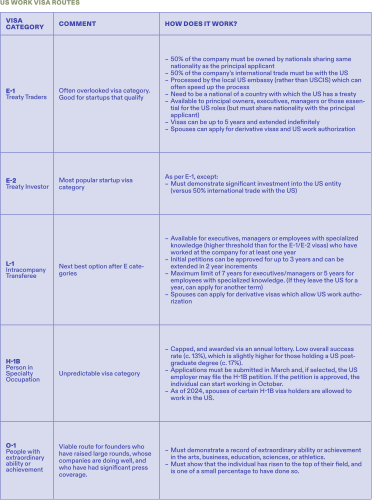
There are five US work visa routes you may use. But most startups go for E-1, E-2, L-1, or O-1 visas.
Visa applications require extensive documentation. Common to all the routes listed above, you will be asked for:
- Articles of Incorporation
- Documents confirming ownership
- Companies House AR01 Report (if in the UK, else national equivalent)
- A detailed breakdown, or spreadsheet, of all funds invested into the US venture
- Evidence of your investment in the US business including signed leases, evidence of IP, and evidence of spending and payments to set up the business
- Evidence that the business is real and active, including state and federal licenses, evidence of ongoing work, and marketing materials
- Business plan with a five-year P&L forecast for the business, including assumptions and a breakdown of start-up costs necessary for the business to become operational
Applying for a Green Card
None of the visa routes above automatically lead to Green Cards or US permanent residency. If you intend to apply for Green Cards, you will need to explore the options well in advance. Founders on E visas can hit problems at the point of sale of their companies when they have not planned ahead.
Immigration specialists
Given the complexities of the US immigration system, it is advisable to work with a specialist lawyer, rather than the immigration department of your corporate law firm. In the UK, the following are highly regarded US immigration lawyers:
- Clintons
- Samartin & Friends
- Pearl Law Group
- Fragomen
The advisory costs for visa applications are approximately £7,000–£10,000 for the first applicant, plus £5,000 per additional applicant.
Lawyer up
A major difference between US and European business culture is the importance of legal counsel. US companies collaborate closely with lawyers to avoid problems, instead of just solving them. The difference in approach stems from a relatively unique aspect of the US legal system. In the US— unlike in much of the rest of the world—each party to a lawsuit typically pays its own legal bill, irrespective of the outcome. Accordingly, even the threat of a legal claim requires a company to make a judgment call as to whether it would prefer to settle the claim (often without leverage, on unfavorable terms) or fight it out in court at its own cost. US companies are aware that the most cost-effective approach is to take proactive advice to avoid that situation altogether.
When you’re doing your budget, take what you expect to spend on legal and professional services and quadruple it. You just need more lawyers for a lot of different reasons–state-by-state regulations, issues with tax filings and stock options, health insurance, a litigious culture. US lawyers are fantastic, but very expensive.
Ben Drury, Co-founder and CEO, Yoto
You should establish a primary relationship with a full-service law firm. Your corporate lawyer there will be able to pull in specialists from other practice areas: employment, equity, commercial, IP, data, etc. Your lawyers can help Americanize your commercial contracts, apply for trademarks and patents, and evaluate data residency, privacy, and regulatory requirements. If you have worked with a smaller local law firm at seed, it may make sense to uplevel your law firm to one with international reach after series A, or at the point of US expansion.
The US has a stronger litigation culture and the costs for legal advice are much higher. For example you can expect twice the UK rates, for a partner at a respectable firm.
Joshua Jian, COO, Credit Benchmark
You should consider a firm which is familiar with the needs of VC-backed tech startups. Ideally, one that operates in both the US and your European home market. These may include:
- Wilson Sonsini
- Cooley
- Goodwin
- Latham & Watkins
- Morrison & Foerster
- Orrick
Initial setup for US operations might cost $10,000. A basic SaaS setup could be as little as $3,000–$5,000:
- Subsidiary set up: $1,000–$2,000
- Employment contracts: $500-$1,000
- Stock option plan: $2,000—$4,000
- Americanize commercial contracts: $1,000–$7,000
- Trademark filing: $1,000–$3,000
- Patent filing: $8,000—$20,000
- Data privacy: variable; a simple SaaS set up could be $1,000, but something bespoke in a regulated sector (e.g., digital health) could go up to $50,000
The Delaware flip
You will need to set up a US company in order to hire your first US employee. (Unless you use an Employer of Record (EOR) which allows you to make a few fast hires without a legal entity in the US. More on the EOR option later on). However, you’ll need to set up a legal entity once you begin to grow the team, and most companies establish a C-Corp in Delaware.
Your C-Corp could be a wholly-owned subsidiary of your European TopCo. Alternatively, you may choose to adopt your US C-Corp as your TopCo. This is commonly referred to as “flipping.” You will need to assess the pros and cons of flipping, and the timing for doing so, with your specialist advisors. Having a US TopCo used to be a requirement of US investors (e.g., Y Combinator), and can be a signal of your ambition, but there are arguments for not rushing to flip immediately.
If you are going to flip, I recommend doing it sooner rather than later. The more developed your business gets, the more shareholders and stakeholders you have, the harder it is to flip.
Joe Stolerman, Index Ventures
There is a stronger logic for flipping to a US TopCo if you are a Magnet archetype, since this playbook implies a majority of your customers, employees and leadership will end up being based in the US. It also makes it more likely that you will have US investors and an eventual US exit (listing or M&A). For the Anchor and Telescope archetypes, the advantages of flipping are less obvious.
We have been advised that we’ll need a minimum of two years with a US TopCo in order to IPO there, so it’s on our timetable.
Pedro Bados, Co-founder and CEO, Nexthink
Explore the tax implications (for example, your qualification for Seed Enterprise Investment Scheme (SEIS) and Enterprise Investment Scheme (EIS) investment in the UK), and the impact of issuing tax-advantaged options to US employees. In certain countries, notably Germany, flipping is treated as a liquidity event with tax consequences; so if you are going to do it, you should do it before you raise any capital.
You should consider how potential investors may perceive a company from your jurisdiction when making TopCo decisions.
André Dubois, Index Ventures
Unless you face specific tax or governance issues, or want to attract solely US investors early on, there might not be an advantage to having a US TopCo. It is good to bear in mind that if you are based in Europe, but with a US legal structure, corporate processes like fundraising may be held up due to timezone challenges, and your familiarity with laws and requirements.
Remember that legal and tax rules change from time to time, and there are macro forces at play beyond your control. While planning in advance is always helpful, you cannot engineer this too closely.
Tax structure
After creating your US subsidiary, you’ll need a tax registration Employer Identification Number (EIN). This can take up to four weeks and is required in order to open a US bank account and run US payroll. However, in certain situations, this can be expedited by a local authorized person (e.g., pursuant to a power of attorney granted in favor of a US local accountant).
You’ll need a transfer pricing policy from the outset, although in the early stages this is simply a document justifying your approach. Once you reach material global revenues, you’ll need a more extensive policy-designed memorandum. Intercompany pricing between US and foreign related parties must be based upon arm’s-length terms, with documentation supporting the reasonableness of the transfer price.
Sales taxes are administered on a state-by-state basis. SaaS services are considered by 50 percent of states to be a tangible good, so your company can be liable for sales tax even in states where the company does not have a physical presence. You need to work with tax accountants to understand the thresholds, and your liability, to make sure you bill clients correctly, and don’t become liable for back-taxes later on. Typically, if you have no presence (employees) in a state and under $100,000 in turnover, you will not need to pay. However, after the Wayfair ruling of 2018, there’s precedent for a state to tax a company, even if it does not have a physical presence there.
Once you have employees or an office, you’ll need to register to do business in that state. You will need to file income tax returns in that state and may also be subject to various city and county taxes. In addition, many states have adopted the market-based sourcing approach to state income taxes where services are apportioned based upon the location of the customer. You will need to work with tax accountants to determine how these rules apply to your income.
Do speak with your lawyers and/or accountants regarding any reporting or other obligations that the entity may be subject to given where the company incorporates, which can vary state-by-state.
Founder taxes and compensation
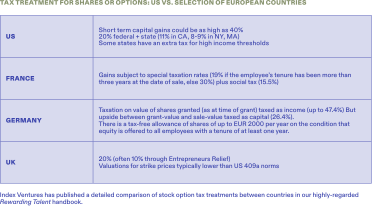
Moving to the US can have major tax ramifications for you as a founder. These will need to be addressed with a specialist advisor in advance. The obvious one is that you will have to file dual tax returns, and look into tax treaties between your home country and the US to see where tax is owed. Most European countries have a dual-tax treaty with the US, making this somewhat simpler. Founders may also be liable for higher taxes in the US on any equity sale due to differences in capital gains treatment.
More challenging, although it is less likely to be an issue for founders before series C, is exploring the tax implications of option grants. We have seen instances where growth shares (often used in the UK, Sweden and elsewhere) are considered to be Restricted Stock Units (RSUs) in the US, and therefore liable for income tax as they vest.
When you move from the UK, you can get hit in two ways: first, entrepreneurs’ relief in the UK is 10 percent, which is much lower than US capital gains. Second, if your shares are treated as RSUs, you may have a large tax bill the moment you relocate to the US.
Dominic Jacquesson, Index Ventures
It’s important to uncover any significant tax issues early, so that there can be a sensible conversation with the board if a founder or other employee is going to be adversely impacted by going to the US. Moving is personally challenging, particularly if you have a family. It should be as positive an experience as possible. It may be necessary to increase salary if the founder is relocating, especially to New York or San Francisco, given their high cost of living. If the move is later in the journey (series B+), you could also explore a secondary sale of founder equity to provide capital for a property purchase or to alleviate personal risk more generally.
Make sure your partner and family feel good about moving. Overinvest to ensure that your quality of life stays at least the same, even if this means extra expense. Your board should be supportive on this.
Pedro Bados, Co-founder and CEO, Nexthink
Banking
When considering your banking partner, you should always pay attention to the networks they have in the geographies relevant to you. To the extent that the US is one of your target markets, it is helpful to go with a banking partner with operations there. This way, when you do expand to the US, you are able to retain a single banking partner with unified online access and reporting.
Compensation and stock options
Prospective US employees will expect to receive stock options and will most likely be more sophisticated in the questions they ask about your plan. We strongly recommend that you set up a US stock option sub-plan, so that you can grant tax-favorable Incentive Stock Options (ISOs). To operate a US sub-plan, you will need to get a 409a valuation every six months, or whenever there is a material event (i.e., anything that could be expected to change the value of the company). This sets the Fair Market Valuation for your option strike price. Depending on your stage of growth and your capital structure, this can typically be 50–80 percent below your last-round valuation, making stock options much more attractive to employees. 409a valuations are fairly straightforward to process, cost $2,000—$5,000, and are offered by many providers, such as Carta.
When moving employees to the US, be aware that your strike price for options may need to be re-calibrated with a US 409A valuation. For example, if they hold UK Enterprise Management Incentive (EMI) options with a more heavily discounted strike price, they will otherwise be liable for additional income tax when it comes to filing their US taxes. It may be necessary to regrant the unvested portion of awards at appropriate 409A strike prices.
One mistake we made was not getting a US 409A valuation, and not issuing options out of a US plan. This became a major problem down the line.
Anonymous European founder
For deeper insight into stock options, we refer you to the Index Ventures handbook Rewarding Talent, and to the section on US stock options in particular.
Payroll, HR and benefits
Many startups use an Employer of Record (EOR) or a Professional Employer Organization (PEO) to manage their employee payroll and benefits. Both provide outsourced HR services for employees outside your home region. The key difference is that EORs employ through their own legal entities, while PEOs require you to establish your own legal entity in the country. EORs are specifically designed to facilitate international hiring without the need for local entities, while PEOs focus on domestic operations. If you’re looking to make a few hires in the US fast, EOR can be a good option. However, if you’re expanding in commercial capacity (which you most likely are), you will need to establish a legal entity. In this case using a PEO makes sense if you’re hoping to move fast.
Look into using Remote before incorporating a subsidiary. It works particularly well as an EOR (helping with compliance, payroll, benefits, etc.) before you reach scale in the US.
Joe Stolerman, Index Ventures
EORs like Remote are recommended when your US headcount is under 10 and you do not have a US legal entity. This is ideal for speedy hiring (can be done in a matter of days) or for standalone satellite hires. EORs employ through their own legal entities in the US and other countries, handling HR activities, payroll, taxes, compliance, and benefits on your behalf. This eliminates the need for hiring your own lawyers, accountants, and payroll providers for US operations. However, if you plan to grant tax-efficient incentive stock options (ISOs) in the US, you should consult legal counsel to determine if a legal entity or a sub-plan is necessary for your equity structure.
PEOs are recommended when you have a registered US entity and plan to hire 5–200 employees (W-2 workers only). This is an ideal solution for an initial beachhead ahead of a full-scale expansion, but often takes longer than an EOR to establish. PEOs operate under a co-employment model, where the PEO handles payroll, benefits, tax administration, HR Information System (HRIS) solutions, and compliance, while your company remains the legal employer. Justworks is a leading PEO in the US, particularly focused on startups and tech companies looking for streamlined HR and benefits solutions.
When your headcount exceeds 200 in a single country, you might want to consider an Administrative Service Only (ASO)— a service similar to a PEO without co-employment and direct insurance benefits—or General Payroll.
US employees tend to pay high attention to health plans. If you’re hiring experienced team members, you’ll be expected to offer a policy covering family members too. The cost of the health insurance depends on the plan (in particular, which hospitals are included and the level of employee-deductible towards any claim), the level of coverage offered, and whether the employee requires insurance for themselves or a family. The cost is roughly $500–$2,000 per employee and employers typically cover 75–85 percent of premiums for single coverage and 67–75 percent for family coverage.
A new alternative is called Individual Coverage Health Reimbursement Arrangement (ICHRA), where a company contributes a fixed sum to an employee’s health plan. The employee is free to pick a plan that works best for their specific circumstances, creating more flexibility compared to company-selected health plans that are decided by HR/founders. Companies like Thatch are an alternative to this process and are worth considering.
Pension plans in the US are referred to as 401(k) plans. Employees make contributions which are deducted from payroll pre-tax and the company administers this transfer of funds. Companies can choose to contribute to an employee’s 401(k), which is a way to offer a competitive benefits package and could contribute to a positive employer brand when competing for talent.
It’s important to have a competitive benefits package to enhance your employer brand when you enter the US market. Offering a great health plan, contributions to 401(k) plans, and extras like telehealth and wellbeing services, will help you attract talent. They also signal your intent to invest for long-term US success.
Camilla Velasquez, former SVP Product Strategy and Marketing, Justworks
Property
You will probably operate from a co-working space when you first land in the US. Not only does this offer flexibility, but you will need a US office address to apply for visas in advance of having anyone on the ground. However, once you have more than five people in the US, it is worth considering leasing your own office space, despite the additional cost and unused space. A permanent space can be fitted out to reflect your culture, and to a spec which matches your European HQ. It signals your commitment to the US, which will be noted by prospective hires, customers, and partners, as well as by employees.
CASE STUDY


-
Capturing kids’ minds across continents.
-
About
Yoto is a screen-free audio player for children, putting kids safely in control of their listening, learning, and play.
-
Founding
London, 2017
-
Founder(s)
Ben Drury, Co-founder and CEO;
Filip Denker, Co-founder and CTO -
Founder location
London
-
Fundraising to date
$43.3 million, series A
-
Headcount
180+ employees globally (70% UK, 15% France, 15% US)
-
Leadership
London
-
Engineering
London
-
US % of revenue
70%
Yoto was born from a moment of parental dismay. When co-founder Ben Drury came across a baby stroller with a built-in iPad holder, it crystallized his growing alarm about his kids’ exposure to screens and digital media. He’d frequently talked about the challenges of modern parenting with his friend and former colleague, Filip Denker, and so the pair decided to build something they wanted for their own kids: a screen-free audio player that let children control the listening experience.
The result was the Yoto, a device that let kids insert physical cards to listen to stories, music and educational content. Yoto tested the market with a successful Kickstarter campaign in 2017, which allowed them to make their first-generation player with a UK manufacturing partner. Although they were based in London, many of their early customers were in the US, and they quickly realized the US represented their biggest market opportunity. The company’s analysis suggested the US market could be six to seven times larger than the UK, driven by at least three key factors: a larger population of families with young children, higher birth rates, and a greater propensity to spend on kids’ education and entertainment.
Early US opportunity
Over 2018 and 2019, Yoto was busy fulfilling orders and learning from their early users to improve the product. They unveiled their second-generation player, designed with renowned creative agency Pentagram, in February 2020 just before COVID-19 hit. Even without the ability to travel or hire locally due to the pandemic, they still managed to launch in the US by June 2020. The company focused on establishing operations through partnerships rather than building a local team, leading them to find an excellent fulfillment partner in California, who could take receipt of Yoto’s products and fulfill customer orders.
Despite the challenges it presented, the pandemic turned out to be a critical turning point for Yoto. With lockdown fatigue, social distancing and mounting concerns about how screen time was filling the gap for kids, Yoto achieved $4 million in revenue in 2020, with the majority coming from Q4.
There’s no doubt we were lucky, if you can call it that. Parents were dealing with virtual schooling, kids were stuck in front of screens doing lessons, and Yoto was a great alternative to screen time. Even though we were super early and no one had heard of us, we started to get real traction.
Ben Drury, Co-founder and CEO, Yoto [BD]
Building the US team
Yoto made their first US hire in late 2020. One of their investors connected them with Sarah Natchez, who has recently left her post as COO for a major soccer program for children throughout the US. Though it would be their most expensive hire to date and the entire interview process had to be conducted over Zoom, the connection was immediate.
We weren’t looking for someone in sales or marketing so much as a person who was just a great operator. Sarah is someone who’s a hustler, someone who could do all the operational side of things. She’s not only a marketer, she’s a great all-rounder.
BD
Yoto chose New York over San Francisco as their operational HQ in the US. Sarah worked out of Brooklyn, and Ben and the Yoto team wanted to be close to major global publishers and content providers—the majority of whom, with the exception of Disney, were based in New York.
I think New York and London are culturally closer; there are so many Brits over there and so many Americans here. They’re sort of sister cities, whereas San Francisco feels completely different.
BD
Even so, Yoto did almost everything out of London, including product, tech, engineering, and customer happiness. At the time, the company didn’t have the resources to extensively localize its marketing efforts. They tended to use the same creatives for campaigns in the US as they did in London and Paris, with minor things like spelling changed for different markets. Yoto sold direct to consumer and online, and all the brand and performance marketing was run out of London. Unlike a B2B company with a top-down sales motion, they didn’t need a big local salesforce.
Sarah did recruit a team around her, focused on marketing, content, and ops. They followed a split reporting structure, with Sarah as the overall US manager, but all US employees also belonging to and reporting into other teams based in the UK.
Remote-first and family-friendly work culture
Being “born in the crucible of COVID-19,” as Ben puts it, has shaped Yoto’s approach to culture, which is grounded in a hybrid working model. In the early days, it helped bridge the gap between US and UK operations, since everyone was working remotely initially. The nature of the product meant many team members had young children, so Yoto maintains flexible working arrangements. Ben himself traveled to the US around two to three times a year during the early expansion phase, proving it was possible to build trust and momentum without constant in-person presence.
Once travel restrictions were lifted, Yoto invested heavily in building relationships through regular in-person trips. Along with Ben, the UK-based Head of Content and Head of Marketing made frequent trips to New York, meeting with publishers and strengthening connections with the US team. Sarah also flew over regularly to London. This two-way flow of talent and ideas has helped prevent the US office from feeling like a satellite operation, which was crucial for attracting and motivating staff. Yoto continues to invest heavily into regular team gatherings and offsite events, including an annual multi-day global offsite known as “YotoFest” bringing the entire company together.
Localization, evolution, and distribution
From the initial $4 million in revenue in 2020, Yoto’s sales continued to double YoY, reaching $67 million in 2023—a validation of their strategy of maintaining lean operations while focusing on product excellence and customer experience. The company’s headcount is currently 180, and expected to grow by over 25 percent by the end of the year.
One of Yoto’s key learnings from their transatlantic journey has been to understand which content would resonate across markets in terms of stories, narration, and accents.
Peppa Pig is British and Paw Patrol is American and both of those work universally. Same for Disney, Star Wars, and Marvel. But then there are things like Enid Blyton, which are very particularly British. With accents, in the US, we found that if the book was originally British, then British accents work—there’s a certain familiarity. But if it’s an American author, it needs to be an American voice.
BD
While Yoto initially focused on direct-to-consumer sales through their website and Amazon, they’ve recently begun expanding into retail. In October 2024, they launched in 1,900 Target stores, marking their first major retail partnership. However, retail remains their smallest channel, allowing them to maintain better margins and cash flow management.
Ben’s top tips for winning in the US
- Get (and pay for) good lawyers: Plan for significantly higher legal costs than what you’re used to at home.
Aside from all the regulatory issues, and a more litigious culture, you need to be really careful with your filings and stock options. Penalties for missing deadlines are really high and getting it wrong on stock options can hit your employees really hard on their tax bill.
BD
- Talent management: Be thorough with background checks and referencing.
Americans are brilliant at selling themselves, but you have to check that the substance matches up. Use back-channel referencing as much as you can.
BD
- Growth strategy: Consider starting with direct-to-consumer before moving into retail.
You want to negotiate from a position of strength. If you’ve got a product that no one’s ever heard of, you have no leverage at all. But if the retailer wants your product, then you’ve got some leverage.
BD

How the hot dog became top dog
Nothing tastes of New York like a hot dog. In the early 1900s, when Luna Park, Coney Island’s amusement park, was in its heyday, an estimated 100 million hot dogs were sold each summer. To this day, the humble wiener is a perennial US favorite, the staple of baseball games, tailgate parties and cookouts. However, this quintessentially American snack was actually a European import. Frankfurt and Vienna (or Wien in German) both claim the hot dog as their own, although the very first sausage is credited to Emperor Nero’s cook Gaius, nearly 2,000 years ago. New York’s first hot dog stand was opened by German immigrant Charles Feltman on Coney Island in the 1860s. A decade later, Nathan Handwerker, one of his employees, set up in competition … creating the celebrated Nathan’s Famous, the champion dog that went on to conquer America.
Stories of Success