INTRODUCTION
The Index Ventures Experience
Starting in Europe can give you an edge. When a European company is truly ready and decides to expand to the US, they can punch above their weight with a different lens on the market.
Danny Rimer, Index Ventures
Every founder eyeing up the US from the outside faces the same question: do we have what it takes? Breaking into such a large and competitive market will probably be one of the most daunting feats you’ll ever face as a founder—but, if you succeed, it will also be one of the most rewarding.
For European founders, the fundamental question is shifting from "How do we expand to the US?" to "How do we build a global company from day one?" Rather than treating US expansion as a bridge to cross at some point, founders are increasingly looking to the horizon and building with transatlantic ambitions from the start.
At Index, we’ve had the privilege of partnering with a number of path breaking European and US companies with a “born transatlantic” mindset, including Figma, Datadog, Wiz, Roblox, Adyen, Revolut and Robinhood. Over the three decades, we've seen 23 of our portfolio companies become decacorns and taken 57 companies to a successful listing. We’ve helped more than 50 European tech companies build global businesses, and the same questions come up from founders again and again. How long should I grow my business in Europe? How do we build our organization to thrive across continents? When and how does the US come into the picture? Does the founder need to move? Where in the US should we set up?
Being involved at every step—from planning through to launch and scaling—has taught us invaluable lessons about the opportunities and pitfalls. We’ve also lived this journey ourselves, being the first and only global venture capital (VC) firm with roots in Europe that’s also made it in the US, opening our first office in San Francisco in 2011. Through this experience and that of the companies we’ve nurtured, we've seen that transatlantic success calls for equal measures of ambition, commitment and trust:
Ambition
This goes beyond just wanting to succeed in the US market. It means having the vision to build a truly global company from the get-go, and the courage to compete in the world's most demanding market. European founders must be willing to think bigger and move faster than they might be comfortable with initially.
European founders today have learned from the stories of success and failure from startups going to the US. They are now equipped to take on the challenge, with more ambition than ever before.
Hannah Seal, Index Ventures
Commitment
Building a transatlantic company requires unwavering dedication to the mission. This might mean founders relocating, extensive travel, challenging timezone management, and significant investment in building and maintaining company culture across continents. It means being willing to make hard choices and stick with them through difficult times.
You have to make it impossible for yourself to fail. How ready are you to make it?
Danny Rimer, Index Ventures
Trust
The foundation of any successful transatlantic organization is trust—between leaders and their teams, between offices, and in the shared mission. This becomes especially critical when operating across timezones and geographies. Building and maintaining this trust requires intentional effort and investment in communication, travel, and team building.
Our research into US expansion is the most comprehensive ever undertaken. We first published this guide in 2020, and are now updating it five years later. We've analyzed over 500 VC-backed startups and surveyed 140 companies about their expansion strategy. We've done deep-dives into 46 European breakthrough companies that have succeeded in the US, as well as interviewed dozens of founders and operators at various stages of expansion. The result is a set of practical frameworks to help you plan and execute the right moves at the right time.
This book will give you insight into these different models and choose the right approach for your company. Whether you're just starting to consider US expansion or already planning your launch, our goal is to help you understand what you need to do, when you need to do it, and how to do it effectively. Most importantly, we want to help you build an organization that can truly thrive on both sides of the Atlantic.
THE ARCHETYPES
Companies born in Europe are now achieving unprecedented scale. While some will remain regional success stories—particularly in regulated sectors like financial services, insurance, property, healthcare and education—the majority of successful European startups will operate globally. For those that become category winners, what are the strategies and factors that enabled success? And how did they design their organizations to maximize their potential?
Most startups born in Europe share similar beginnings. A founding team based in Europe develops a product vision, raises angel or seed funding, and builds their early team locally. They typically find their first users or customers in Europe, though an increasing number are finding early US customers through personal networks, investor connections and remote marketing activities. Through working with these initial users, they achieve product-market fit (PMF). It’s usually after hitting PMF that companies’ paths diverge dramatically, shaped by both their sector and business model.
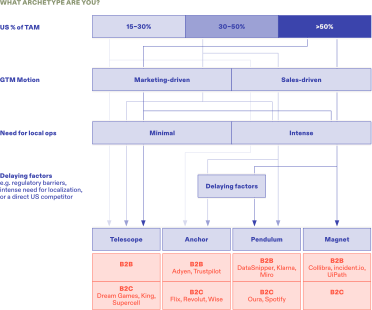
Through working with hundreds of companies making this journey, Index has identified five distinct archetypes for building transatlantic businesses out of Europe:
- Magnet: companies that begin in Europe but pivot to the US quickly. Most enterprise Software as a Service (SaaS) companies fall into this archetype where the US is their largest market and most of their revenue comes from the US. The company builds commercial functions in the US while keeping the core of engineering in Europe. The founder/CEO relocates and the executive team will eventually be in the US.
- Pendulum: companies that balance between the two continents, maintaining multiple centers of gravity. Either the total addressable market (TAM) is more equally weighted across Europe and the US, in which case Pendulum is a natural archetype, or companies have a large US TAM but their US entry is delayed. This might be due to regulatory barriers, need for intense localization, or a direct US competitor. This delay means that you will end up building substantive operations in Europe before entering the US. Pendulums typically have a US President and some US-based functional executives with the founder/CEO navigating between the two continents.
- Anchor: Anchor is focused on Europe with a small proportion of their revenue coming from the US. The TAM is weighted to Europe and the US share of revenue lands somewhere between 15 to 30 percent. The founder/CEO stays in Europe. They’ll typically have a US President, but no other US executives.
- Telescope: a company that is able to serve US customers without building a big US presence. This is a common archetype for companies that rely on bottom-up, self-serve motion. Their US share of TAM and revenue can vary. The founder/CEO remains in Europe and they’ll have a VP of business development in the US.
- Transplant: European founders who move to the US and start their companies there. While this is a valid path to pursue, it will not be the focus of this book.
The right archetype for your company depends primarily on two key questions:
- How large is the US as a percentage of your total addressable market (TAM), and to what extent are you focused on winning this market?
- Do you need boots on the ground to either acquire (sales) or serve (operations) customers?
While other factors influence which archetype fits best, these two factors tend to be the most decisive for both B2B and B2C companies. The classic business tenet of “follow the customer” remains paramount.
These archetypes are road-tested heuristics that offer guidance on critical decisions about timing, team structure and geographic focus. But they’re not static: companies can evolve from one archetype to another as they scale. These changes are usually driven by shifting go-to-market (GTM) strategy: for example, you might move from a Telescope to Magnet as you establish a sales motion to focus on enterprise customers.
To help determine which archetype fits your company, and to visualize what your journey to becoming a transatlantic company might look like, check out our ExpansionPlan web app, available on the Index Ventures website, in the Index Press section.
KEY TRENDS
The European tech ecosystem has evolved dramatically over three waves, each marked by a distinct approach to US expansion:
- First Wave (pre-2010): The Transplant Era. Successful European companies typically transplanted themselves wholesale to America. Success involved relocating entirely to the US and building a US business from the get-go. This was largely driven by dominance of US investors and their preferences.
- Second Wave (2010–2020): The Hybrid Approach. More nuanced approaches emerged, with companies such as Adyen and Spotify taking advantage of Europe’s tech-savvy customers, talent, and capital to grow in Europe first before expanding.
- Third Wave (2020–present): Born Transatlantic. European companies increasingly building for global markets from the get-go, intentionally designing the organization to be able to operate across continents from inception or in the near future.
We've designed the company on the US model from the ground up—everything from how we approach internal communications, equity, team lunches. So I don't think it was hugely challenging to assimilate into Silicon Valley.
Alex Kendall, Co-founder and CEO, Wayve
Europe has witnessed an extraordinary growth in talent density, the rise of transformational technologies for building and scaling companies, and a new ecosystem of knowledge and playbooks driven by increasingly sophisticated operators, investors and policymakers. The region has created 571 unicorns (with 22 additions in 2024 alone), and 37 decacorns.¹ European startups now account for 20 percent of global VC deals, and secure a third of global seed funding.²
The advantages Europe offers as a foundation for building global companies have become increasingly clear:
- Deep technical talent pools, with more affordable salaries and better retention rates
- Smaller domestic markets that force international thinking from day one
- Domain expertise in sectors like finance, luxury, travel, and gaming
- A growing ecosystem of experienced operators, investors, and advisors
The one thing that we definitely lacked a decade ago in Europe is people who have experience of massive scale. But these days it is different, as there are companies in Europe who have gotten to scale, and therefore we have people who have experience of it. I think it gives a great starting point for the next wave of companies.
Ilkka Paananen, Co-founder and CEO, Supercell
Here are some key drivers of recent trends:
- The rise of remote working since the pandemic, leading to increased experimentation with distributed teams from the outset.
- The rise of AI , leading European companies to focus earlier on the US, especially the Bay Area, in order to access AI-productization talent, key platform partners or US investors taking a lead on AI investments.
- A widening economic gulf between the US and Europe. Stronger US macroeconomic growth and a rebound in investing, especially in AI, is pushing European founders to look to the US sooner than they would have during the second wave.
Since the last publication of this book, here are some of the emerging trends:
1 A maturing European ecosystem with a research and development (R&D) advantage:
The European ecosystem now offers distinct talent advantages compared with the US, including world-class technical expertise at significantly lower cost. Engineers in Paris or London typically cost half what equivalent roles command in New York or San Francisco, while offering similar quality and often greater loyalty. This means European companies are confidently maintaining their engineering core in Europe, while strategically adding specialized expertise from the Bay Area or New York. This bifurcated approach across continents is so successful that US companies such as Figma, OpenAI, Scale, and Cohere have looked to Europe as a source of technical innovation and talent.
2 Earlier, bolder entry to the US:
Startups are targeting transatlantic expansion earlier than ever before: 64 percent of companies now expand to the US at pre-seed or seed stage, up from just 33 percent in 2015–2019.
3 An enterprise spending gap:
While much ink has been spilled on the funding gap between the US and Europe, corporate spending is an increasingly significant part of the picture. US enterprises are typically more open and faster in buying from startups and have larger technology budgets. According to Statista, the enterprise software market in the US is projected to reach $195 billion by 2029, more than double Europe's $90 billion³. US corporations see technology as a source of competitive advantage and are willing to bet on innovative solutions—and closing just a few major US enterprise deals can transform a company's trajectory. Being close to customers remains the primary motivation for expansion, with 76 percent of founders surveyed ranking it as their top reason.
4 The resurgence of Silicon Valley:
Despite predictions of Silicon Valley's decline during the pandemic, the Bay Area has reemerged as the epicenter of AI innovation, with unparalleled energy and opportunities. 46 percent of companies that expanded to the US from 2020–2024 are choosing the Bay Area as their hub, up from 28 percent for those who expanded to the US from 2015–2019. The concentration of extraordinary talent, investors and customers creates a flywheel of serendipitous connections that's difficult to replicate elsewhere. Whether at industry events, coffee meetings, or even local gyms and yoga studios, informal networking gives local companies an edge.
Great entrepreneurs can come from anywhere and be anyone. But when it comes to talent and opportunities, for me, it’s the West Coast versus everywhere else. Silicon Valley is the Premier League.
Danny Rimer, Index Ventures
At the same time, founders are increasingly deliberate about the location of their US hub, with many choosing New York due to proximity to customers and favorable timezones. Now, companies are increasingly committing to primary tech hubs (Bay Area, New York, Boston, Los Angeles) at the start to maximize their chances of success. While other locations can offer short-term cost advantages, they often create growth ceilings. The trend of establishing an American headquarters (HQ) in lower-cost US cities like Austin or Denver was more common in the period after the pandemic, but is now reversing, with secondary cities launching only after companies scale.
5 Experimentation with team distribution
The normalization of remote work has loosened some of the demands around geographical locations and companies have become increasingly sophisticated about balancing the advantages of in-person versus remote workplace cultures. There’s a growing recognition of the advantages of having multiple centers of gravity within the “10-hour timezone” from San Francisco to Tel Aviv, allowing companies to flex operations according to economic cycles, regulatory shifts or geopolitical tensions. Across all archetypes, companies are keeping their engineering core in Europe while building commercial operations that span both markets. Some specific emerging models include:
- A preference for in-person US hubs: Remote meetings have made it increasingly easy to establish an initial US presence and win customers without committing to a physical office. Companies can hire their first US employees wherever they find the right talent, whether that's in North Carolina or New York. Despite this, we're seeing a preference for in-person cultures in the early days of expansion. Over 70 percent of surveyed founders believed being in an office together was important during the initial US launch.
- Hiring global R&D talent from the outset: Companies falling into Magnet and Telescope archetypes are making early technical hires in the US, particularly for AI talent in the Bay Area. However, there is risk involved when R&D is spread across timezones and the CTO should ideally always be close to core R&D builders.
- Some delayed founder relocation: Some founders are building globally successful businesses without personally relocating to the US, even when the US is their largest market and revenue driver—though it remains to be seen if this holds true through to exit.
6 Companies are growing leaner, better, faster
Successful startups are becoming leaner relative to revenue, driven by rising interest rates, increased focus on productivity and efficiency in the post-pandemic era, and advances in AI. We’ve seen an increase in the average Annual Recurring Revenue (ARR) at the point of listing, and a roughly 20 percent cut in headcount throughout the journey. Winners can win even bigger now than before, and can do so with fewer people.
¹ Dealroom, Europe Q3 2024 Report (October 2024)
² Dealroom, Europe Guide
³ Statista, Enterprise Software—United States: Market Revenue
KEY CONTRIBUTORS
Here’s a selection of the companies who contributed insights to this resource.
- Adyen
- Celonis
- Collibra
- Cradle
- Criteo
- Datadog
- DataSnipper
- DeepL
- ElevenLabs
- Flix
- Fireblocks
- GetYourGuide
- Hugging Face
- incident.io
- King
- Miro
- MySQL
- Oura
- Personio
- Pigment
- Remote
- Revolut
- Snyk
- Spotify
- Supercell
- Sword Health
- Trustpilot
- UiPath
- Unity Technologies
- Wayve
- Wise
- Wiz
BREAKTHROUGH COMPANIES
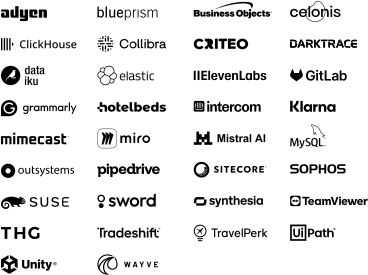
Our research identified 46 European-born tech companies that have gone on to achieve significant success in the US. Success has been defined through a combination of total US revenues, US growth, US percentage of overall revenues, and US category leadership. They span across different industries, business models, and expansion strategies.
B2B
B2C


DESIGN FOR LIFE
Founded in Weimar in 1919 by German architect Walter Gropius, the Bauhaus school of art and design lasted just 14 years and hosted fewer than 1,300 students. But its ideas and influence are still prevalent today—all over the world. The schools’ guiding principles were stripped-back minimalism, function before form, and an aesthetic fusion of craft and mass production. This was applied to all kinds of disciplines—from graphic design and furniture, to architecture and photography. Modernist Bauhaus values inspired later design movements, including Scandinavian, industrial and mid-century modern. And they are still with us today, epitomized by Apple devices, Herman Miller furniture, International Style architecture—even everyday items like teapots from Target. That’s not surprising. As World War II broke out, many of the movement’s leading lights fled to America or elsewhere in Europe, keeping the Bauhaus flame alive. These days, it’s so ingrained in the US cultural landscape as to be almost invisible.
Stories of Success